
Cerebras Systems Buy the Dip
OpenAI partnership, disaggregated inference, a 900,000-core architecture and weight streaming, and what the Q2 2026 numbers actually show
Part of theAI Stocks Center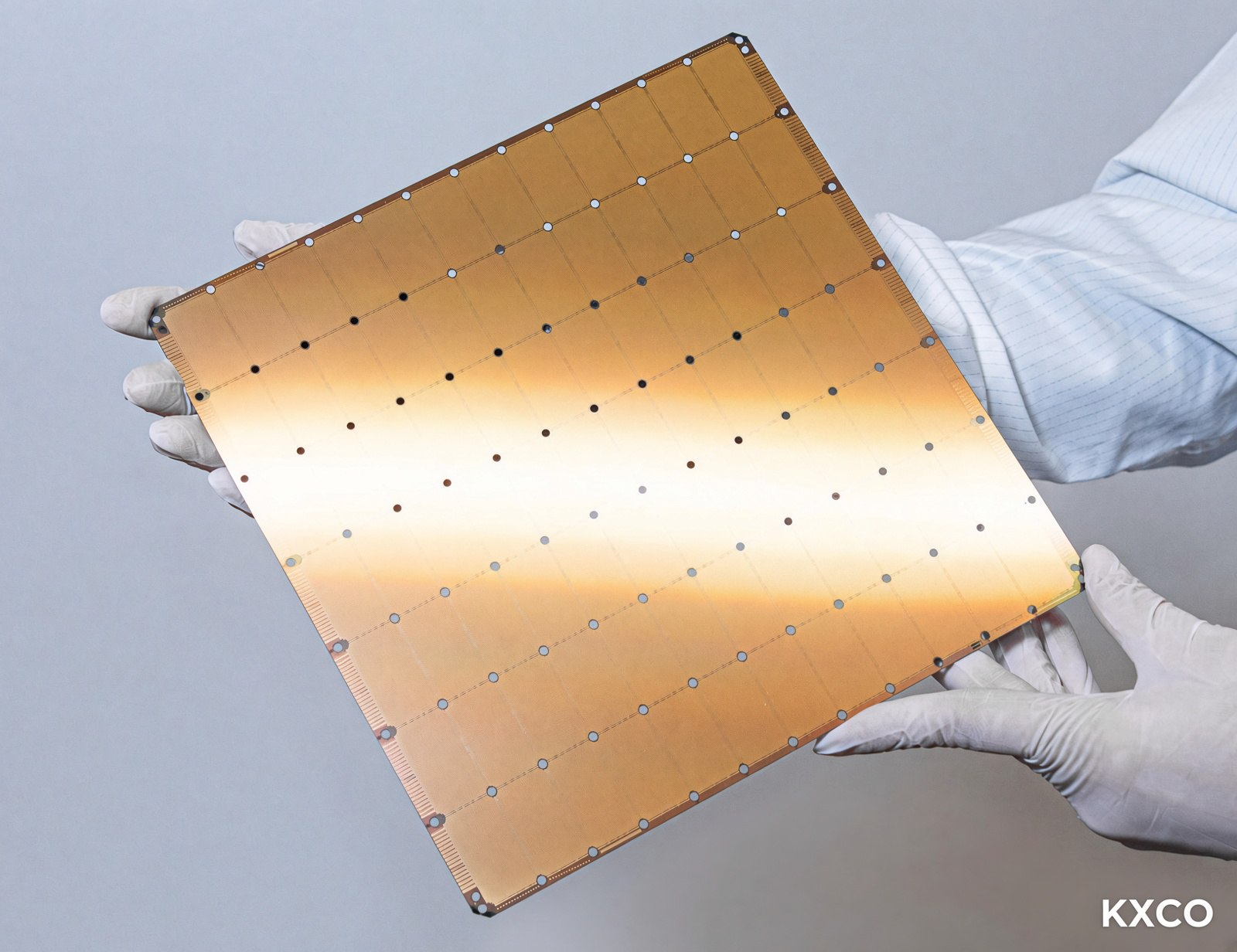
Cerebras Systems has become one of the most consequential pure-play AI infrastructure companies of the decade, and the second quarter of 2026 is the point at which the numbers stopped being a story about promise. Core total revenue reached $209.9 million, up 103% year over year. Core cloud and other services revenue, the fast inference business, hit a record $127.7 million, up 287%. Data-centre capacity under contract passed 600 MW. The company raised its 2026 core revenue outlook to between $880 million and $890 million. OpenAI selected Cerebras as a launch partner for GPT-5.6 Sol, delivering the frontier model at roughly 750 tokens per second, and partnerships with AMD and AWS have established Cerebras as the clear leader in disaggregated inference.
This is not incremental progress. It is commercial validation of a radically different compute architecture: the Wafer-Scale Engine 3.
In May 2026 I published an initial overview of the WSE-3 on Live Trading News, AI News: Cerebras WSE-3 $CBRS $NVDA. That piece introduced the headline specifications. This article goes deeper: the hardware microarchitecture, the co-designed software stack, the system-level engineering required to power and cool a 25 kW wafer, the MemoryX and SwarmX weight-streaming fabric, and the disaggregated inference paradigm now reshaping how frontier models are served.
The goal is practical understanding for investors, operators and builders who need to evaluate whether wafer-scale silicon belongs in their inference and training roadmaps. We examine not only the silicon but the full vertical stack, from TSMC process choices and defect-tolerant design through cooling, power delivery, compiler technology, and the commercial contracts that now underwrite multi-year capacity expansion.
The Architectural Bet: One Wafer, Not Thousands of Chips
Traditional GPU clusters solve the memory wall by partitioning models across hundreds or thousands of discrete dies, then spending enormous energy and latency on all-to-all communication. Cerebras inverted the problem. Instead of dicing a 300 mm wafer into many small chips and reconnecting them with copper and optics, Cerebras stitches the entire wafer into a single processor.
The WSE-3 is fabricated on the TSMC $TSM N5 process. It measures approximately 46,225 mm², roughly 21.5 cm on each side, and contains about 4 trillion transistors. Roughly 900,000 AI-optimised cores remain functional after defect mapping and redundant routing. On-chip SRAM totals 44 GB, delivering 21 petabytes per second of memory bandwidth, and the on-wafer fabric carries 214 petabits per second.
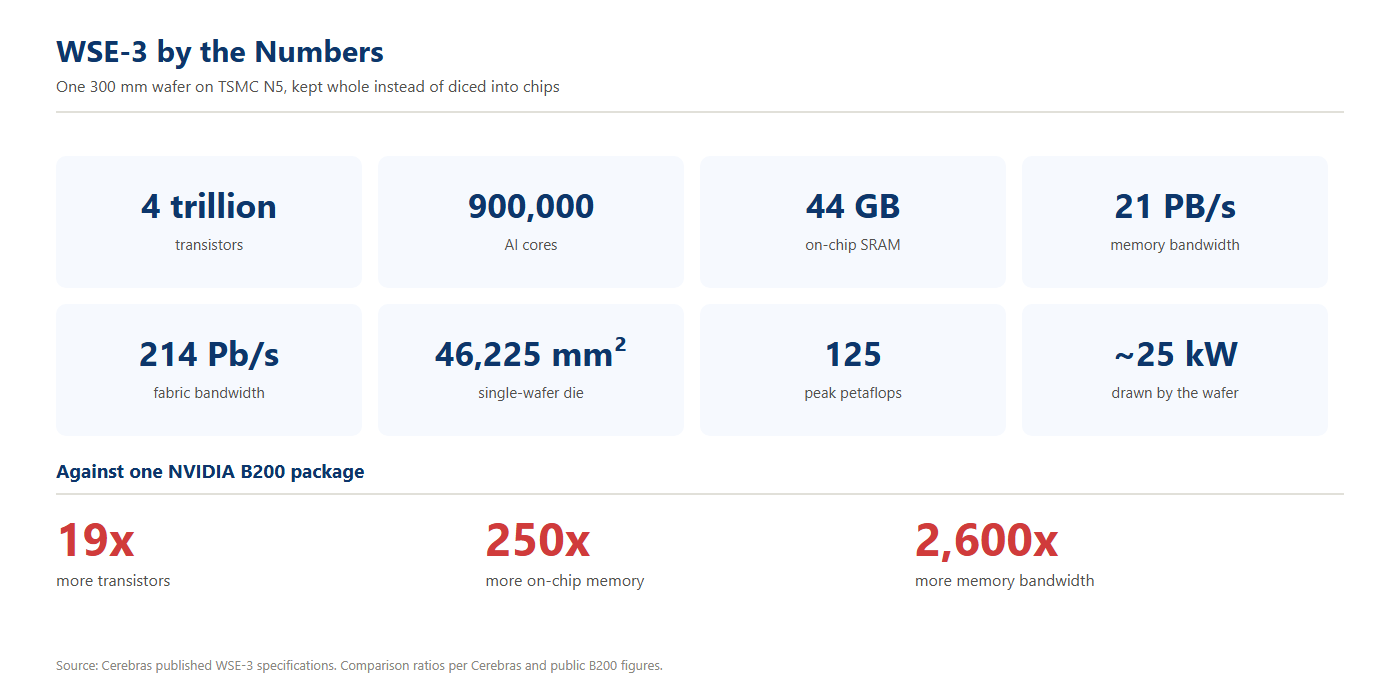
The WSE-3 in figures, and the multiples against a single NVIDIA B200 package.
These are not marketing abstractions. A single WSE-3 carries 19 times more transistors, 250 times more on-chip memory and more than 2,600 times the memory bandwidth of an NVIDIA B200 package. Because the cores sit on one continuous piece of silicon, communication between them happens over short, low-power, high-bandwidth metal rather than across package boundaries or network hops.
Note what that last figure does and does not say. It is a comparison of one wafer against one package, not against a rack or a pod. NVIDIA sells systems, and an NVL72 rack aggregates a great deal of bandwidth across its dies. The wafer-scale advantage is real, and it is specifically an advantage in where the bandwidth sits: on the die, adjacent to the compute, rather than across an interconnect.
Yield is managed through deliberate over-provisioning and runtime remapping. Defective cores are deactivated and the 2-D mesh fabric routes around them. Manufacturing innovations make the approach viable at volume: scribe-line wiring that turns keep-out zones into interconnect, compliant connectors, vertical power delivery, and coefficient-of-thermal-expansion matching.
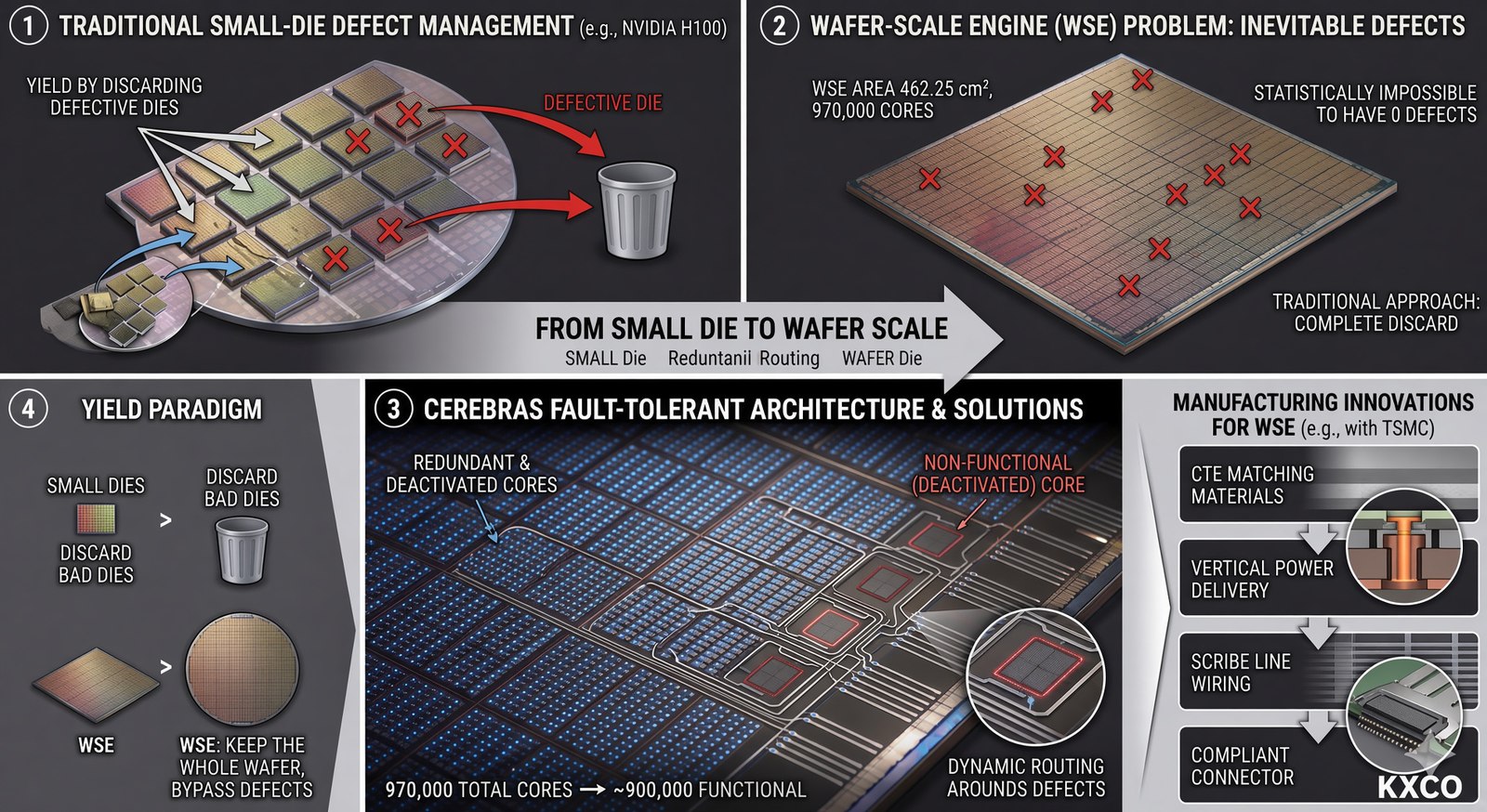
The yield inversion. A conventional line discards defective dies. Wafer-scale keeps the whole wafer and routes around the defects.
Cerebras has secured TSMC wafer supply and contract manufacturing capacity, with Flex, Sanmina and Rocket EMS, to scale production more than tenfold in 2026.
The decision to stay on TSMC's N5 node rather than chase the most advanced 3 nm processes is itself strategic. By avoiding HBM, CoWoS advanced packaging and the most constrained leading-edge capacity, Cerebras sidesteps several of the industry's tightest bottlenecks. The wafer-scale approach therefore carries a dual advantage: architectural uniqueness and relative supply resilience. That is one reason the company could commit to multi-hundred-megawatt deployments on relatively short lead times after the OpenAI agreement was signed. It is also worth reading alongside the wider constraint on the whole build-out, which is electricity rather than silicon.
Inside the Core and the Fabric
Each processing element is a fine-grained dataflow core with local SRAM, a small instruction cache, registers, and SIMD datapaths optimised for sparse matrix operations. The core executes when data arrives rather than under a traditional program counter. This dataflow model suits the unstructured sparsity common in modern neural networks: zero weights are simply never delivered, and the hardware skips the corresponding work.
The cores sit in a uniform 2-D mesh. Fabric links provide nearest-neighbour communication at very high bandwidth and low latency. Because the entire wafer is one logical device, software never has to manage inter-die synchronisation for models that fit in on-chip SRAM.
For models larger than 44 GB of weights, which means the vast majority of frontier models, Cerebras uses weight streaming. Parameters and optimiser state live in an external MemoryX system, hybrid DRAM and flash, scalable from a few terabytes to more than a petabyte. Weights stream layer by layer into the wafer. Activations stay resident on it. On the backward pass, gradients stream back to MemoryX for the weight update. When multiple CS-3 systems run as a cluster, SwarmX handles weight broadcast and gradient reduction.
This disaggregation of memory and compute is the key insight. Model size is no longer limited by on-chip SRAM capacity. Training and inference scale by adding CS-3 nodes while the programming model stays essentially single-device. The Cerebras software stack compiles a PyTorch model once, and changing a configuration parameter expands the job across the cluster.
Wafer-scale integration was long considered commercially impractical because of yield and thermal challenges. Cerebras's successive generations, from WSE-1 on 16 nm through WSE-2 on 7 nm to WSE-3 on 5 nm, demonstrate that careful co-design of core, fabric, power and cooling turns the theoretical advantage into a shipping product. Core count has risen from roughly 400,000 to 900,000, and peak AI performance now stands at 125 petaflops. Each generation also refined the dataflow instruction set and sparsity support, letting the hardware skip zero-valued operations natively rather than relying on software pruning alone.
The CS-3 System: Power, Cooling and Integration
A WSE-3 alone is not a usable product. It is housed in the Cerebras CS-3, a fully integrated rack-scale unit delivering power, cooling and host I/O. The wafer itself draws approximately 25 kW, and power reaches it through custom three-dimensional distribution networks carrying tens of thousands of amps.
Cooling is liquid-based. Early two-phase solutions evolved into single-phase liquid-to-liquid or liquid-to-air configurations developed with partners including LiquidStack, now part of Trane. The thermal design holds acceptable junction temperatures across a die whose power density averages roughly 50 W/cm² before hotspots.
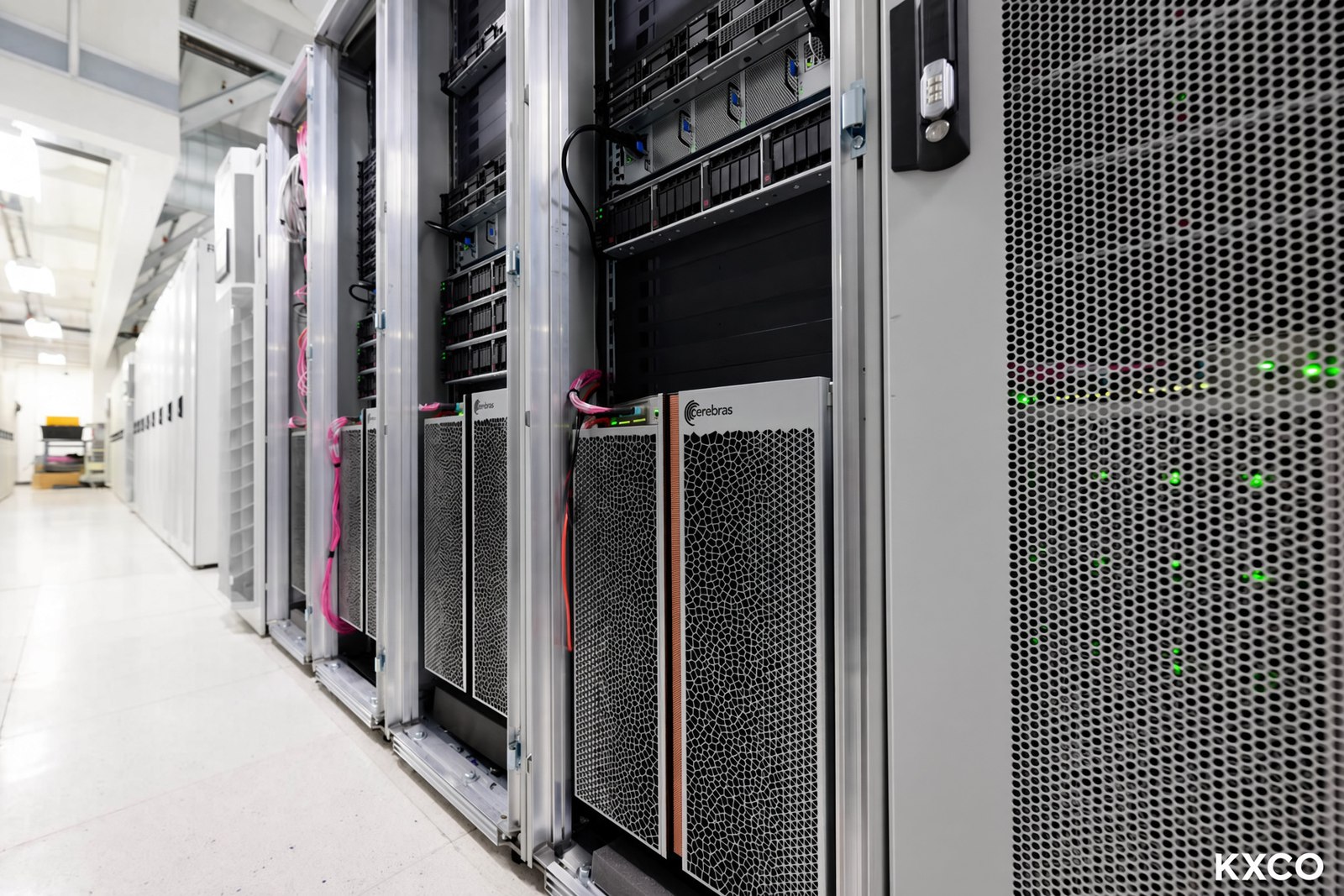
CS-3 systems in a production data-centre row. Each unit houses one WSE-3 wafer with integrated liquid cooling and power delivery.
Multiple CS-3 systems interconnect over high-speed Ethernet and form larger wafer-scale clusters. Cerebras has demonstrated configurations up to thousands of nodes. In practice customers deploy clusters sized to their model and latency targets rather than chasing theoretical maximums.
Set that 25 kW figure against the industry backdrop. Racks that drew tens of kilowatts a few years ago now approach or exceed 100 kW, and a single CS-3 lands squarely inside that new envelope. The 600 MW under contract is the number that matters commercially, because it is a claim on grid capacity as much as on silicon.
Software Stack: From PyTorch to Production Tokens
Hardware advantages evaporate without usable software. Cerebras co-designed its stack with the wafer architecture. The graph compiler takes a standard PyTorch model and maps it onto the wafer without requiring CUDA or manual model parallelism. Two execution modes exist: pipelined, with all layers resident, for smaller models, and weight streaming, layer by layer, for large ones.
The inference serving stack exposes an OpenAI-compatible API. Developers point existing applications at a Cerebras endpoint by changing a base URL and an API key. A lower-level SDK and the Cerebras Software Language allow custom kernels for researchers who need them. A cluster manager handles scheduling, health and telemetry across multi-system deployments.
The practical result is that a team already proficient in PyTorch can move a model onto Cerebras with far less friction than traditional distributed GPU programming. Production hardening has reached the point where OpenAI runs frontier models on the platform. Support for GPT-5.6 Sol at 750 tokens per second is direct evidence of software maturity at hyperscale reliability.
Under the hood the compiler maps tensor operations onto the dataflow cores and fabric. Because the wafer is treated as a single device, many of the model-parallel partitioning decisions required on multi-GPU systems simply disappear. For very large models the weight-streaming runtime orchestrates layer-by-layer traffic between MemoryX and the wafer, overlapping communication with computation where possible. The serving stack sits on top, exposing familiar endpoints while routing traffic across CS-3 resources and managing continuous batching for high utilisation.
Disaggregated Inference: Prefill on GPUs, Decode on the Wafer
The most important recent architectural development is disaggregated inference. Inference has two phases with different characteristics. Prefill, or prompt processing, is compute-heavy and rewards high arithmetic intensity. Decode, or token generation, is sequential and bound by memory bandwidth.
Cerebras's extreme on-chip bandwidth makes it exceptionally strong at decode. AMD $AMD and AWS $AMZN have both partnered with Cerebras on hybrid solutions in which AMD Helios or AWS Trainium handle prefill while CS-3 systems handle decode, the two linked over standard high-speed fabrics. Early results claim up to a fivefold improvement in tokens per second per watt against homogeneous GPU deployments. That figure comes from the vendors rather than from independent testing, and it should be read as a directional claim until third-party benchmarks land.
These solutions are scheduled for production availability in late 2026 with AMD and in early 2027 via Amazon Bedrock. The approach expands the addressable market for both parties. GPUs keep the high-throughput market while Cerebras supplies the latency-critical generation engine.
The economics follow the architecture. Because prefill and decode have different optimal hardware profiles, operators can right-size each portion of the fleet rather than over-provisioning a homogeneous GPU pool for the more demanding of the two phases. High tokens-per-second density on the decode side reduces the number of systems needed for a given interactive latency target, which lowers both capital and power cost for that slice of the workload.
Performance in Practice and Market Positioning
Benchmarks and customer reports consistently show large advantages on memory-bound inference workloads. Cerebras has demonstrated more than 2,000 tokens per second on large open models and 750 tokens per second on GPT-5.6 Sol. For agentic and interactive applications, the reduction in time-to-first-token and inter-token latency changes what is buildable. Training scales close to linearly with additional CS-3 nodes under weight streaming, and the same compiled graph runs on one system or many.
Cerebras completed its IPO on Nasdaq in May 2026, pricing in a $125 to $135 range and valuing the company at roughly $26 billion to $27 billion. The multi-year OpenAI agreement covers 750 MW of inference capacity deployed in tranches through 2028 with potential expansion, and the OpenAI and AWS partnerships together have been reported at over $20 billion. AWS and AMD also dilute the earlier customer concentration risk around G42, which was the most-cited objection to the equity story before the IPO.
Manufacturing and data-centre capacity are the current constraints. Cerebras has responded by expanding contract manufacturing lines and securing long-term TSMC supply. Capacity under contract now exceeds 600 MW with a pipeline measured in gigawatts. Deployments span the United States, Canada and Europe, with discussions active in the Middle East, Asia and Australia.
Ontology, Structure and the Broader Compute Landscape
At KXCO we spend considerable time on structured knowledge representation, through Armature L1, the ontology engines and verifiable on-chain attestation. The same principle of clean separation of concerns that makes weight streaming powerful also shows up in well-designed knowledge graphs. Compute, storage and communication are specialised and loosely coupled rather than forced into one homogeneous fabric.
Cerebras's architecture is a concrete realisation of that idea at the silicon level. It does not replace GPU clusters for every workload. It dominates the latency-sensitive, memory-bandwidth-bound slice of the market that is growing fastest as agentic and real-time applications proliferate. The public ontology at kxco.ai/ontology-live maps the same supply chain this article describes, with every claim carrying its source and its as-of date, which is the only way a dependency map of this kind stays honest as it ages.
Further technical background on wafer-scale design, sparsity support and the dataflow execution model appears in Cerebras's Hot Chips disclosures and in the public developer documentation at docs.cerebras.ai. The company's weight-streaming papers remain the best primary sources for implementers.
Competitive Context and Investor Considerations
NVIDIA $NVDA continues to dominate the overall AI accelerator market through CUDA, product cadence and software maturity. Cerebras does not compete head-to-head across every workload. Its strength is concentrated in memory-bandwidth-intensive inference, and in training scenarios where a single logical device reduces software complexity. Company disclosures and third-party analyses, including SemiAnalysis, have highlighted both the performance advantages and the remaining constraints, particularly the modest growth in on-chip SRAM across process nodes and the engineering cost of cooling a full-wafer thermal load.
From an investor perspective the key variables are execution on the capacity ramp, sustained gross margins as manufacturing scales, and the durability of the OpenAI and hyperscaler relationships. The shift from a hardware-systems company with concentrated early customers toward a cloud inference platform with diversified demand is already visible in the quarterly numbers, with cloud revenue up 287% year over year. Whether that becomes durable pricing power will be clearer as more capacity comes online and competitive responses emerge.
Two cautions belong in any honest assessment. GAAP total revenue of $180.1 million grew 74%, meaningfully slower than the 103% core figure, and the gap between those two measures is worth understanding before quoting either. And a business whose visibility rests on one 750 MW anchor customer has traded G42 concentration for OpenAI concentration rather than eliminating concentration altogether.
For operators evaluating the platform the decision framework is reasonably clear. Workloads that are decode-bound, interactive or agentic, and that can tolerate a specialised inference path, stand to gain the most. Training workloads that benefit from simplified distribution and high sparsity can also find a home. Pure dense training at maximum scale across thousands of GPUs remains NVIDIA's domain for the foreseeable future. Hybrid deployments that place Cerebras in the critical latency path while using conventional GPUs for prefill or less time-sensitive batch work are likely to become common.
Looking Ahead
The next twelve to eighteen months will test whether Cerebras can execute the manufacturing and data-centre ramp its OpenAI and hyperscaler commitments require. Software maturity is no longer the primary question, since the company is already serving production frontier models. Power delivery, cooling density and supply-chain scaling remain the operational challenges.
If those are met, the combination of monolithic wafer-scale bandwidth and disaggregated system design positions Cerebras as a permanent, specialised layer in the AI infrastructure stack, particularly for the decode phase that determines the interactive experience users actually feel. Speed is not a feature. In the inference era it is the product, and Cerebras has built the silicon to deliver it.
Further out, the company has indicated work on photonic interconnect hybrids and continued system-level refinement that keeps the same N5 silicon while raising clock rates and power envelope. The core architectural thesis, massive on-wafer SRAM bandwidth plus external weight storage, looks durable across the next several process nodes. Whether competitors attempt similar wafer-scale designs, or the industry keeps pursuing ever-larger multi-die GPU packages, remains open. For now Cerebras occupies a distinct and increasingly valuable niche.
Key Technical Takeaways
WSE-3. About 4 trillion transistors, 900,000 cores, 44 GB of on-chip SRAM and 21 PB/s of memory bandwidth on a single 46,225 mm² TSMC N5 wafer, with 214 Pb/s of on-wafer fabric and 125 petaflops of peak AI performance.
Dataflow cores and a 2-D mesh eliminate inter-die communication for models that fit on-wafer. Weight streaming via MemoryX extends capacity to trillions of parameters.
The CS-3 delivers roughly 25 kW to the wafer with custom power distribution and liquid cooling, developed with LiquidStack, now part of Trane.
The stack compiles PyTorch directly and the OpenAI-compatible inference API makes migration close to free for existing applications.
Disaggregated inference, Trainium or Helios for prefill and Cerebras for decode, is claimed at up to 5x tokens per second per watt and enters production between Q4 2026 and Q1 2027.
Commercial visibility. A 750 MW OpenAI commitment through 2028, more than 600 MW of capacity under contract, 2026 core revenue guided to $880 to $890 million, and manufacturing scaling more than tenfold in 2026.
Shayne Heffernan, Ph.D. is the founder of Live Trading News and KXCO.
Prior coverage: [AI News: Cerebras WSE-3 $CBRS $NVDA](https://www.livetradingnews.com/ai-news-cerebras-wse-3).
This article is for informational and educational purposes only and does not constitute investment advice. Past performance is not indicative of future results. Always conduct your own due diligence.

SpaceX the AI Company
Read SpaceX against the structure of the AI sector and it stops being a launch company. Anthropic rents an entire 220,000-GPU facility from it. Alphabet pays $920m a month. Remove SpaceX from the record and four major banks and three arms of the American state disconnect from AI entirely.

A Linear Look at AI: Power, Compute, Intelligence
AI is not weather. It is the last station on a production line that starts at a turbine. Read linearly, the sector looks very different: China owns the power layer, the United States owns compute and models, and the conversion ratio between them is the number that matters.

AI Stocks: What to Buy Now
A dated, checkable one-month scoreboard on the KXCO showcase ontology, the Nvidia move up the stack, Alibaba's $10.2bn raise, the Trump SpaceX disclosure, and the seventeen AI majors ranked by implied upside at the 24 August close.

KXCO Releases an AI SEO Extension for Chrome
Bot traffic is forecast to pass human traffic in 2027. KXCO has released a free Chrome extension that grades any website on how legible it is to the AI agents doing the reading. We tested fourteen well-run sites and none scored an A.
Every story, signed and delivered.
Subscribe to the kxco channel and get the headline, the AI-written key takeaways, and the chain-anchor link the moment we publish. Audio versions and per-ticker subscriptions arrive in the next iteration.