

Markets, FX, Crypto, AI and Quantum — Monday, May 25, 2026

KNIGHTSBRIDGE DAILY BRIEFING
Markets, FX, Crypto, AI and Quantum — Monday, May 25, 2026
Authored by Dr. Shayne Heffernan | Published on LiveTradingNews
Bangkok / New York — published 23:00 ET, May 24, 2026
U.S. equity markets enter the long Memorial Day weekend at fresh records after a quiet but bullish Friday session: the S&P 500 settled at 7,473.47 (+0.4%), the Dow added 294 points to 50,580 (+0.6%) and the Nasdaq Composite eked out 26,343.97 (+0.2%). Nvidia traded $215.33 (-1.9%) on a post-earnings unwind after delivering Q1 FY27 revenue of $81.6 billion and a Q2 guide of $91 billion. Bitcoin held the $77,000 line into the holiday at $76,988 with stablecoin float through $323 billion. Knightsbridge has been positioned for a steeper US curve, a softer dollar into the holiday and an AI-x-crypto convergence trade since the January re-allocation, and Friday's tape vindicated that posture.
The Magnificent Seven
Ticker | Close ($) | Day % | Day $ | Vol (M) | 52-wk Hi | 52-wk Lo | Mkt Cap ($T) | Fwd P/E |
|---|---|---|---|---|---|---|---|---|
AAPL | 308.82 | (0.1%) | (0.42) | 43.7 | 311.40 | 193.46 | 4.59 | 32.4 |
MSFT | 418.57 | (0.1%) | (0.52) | 22.0 | 468.10 | 352.18 | 3.11 | 30.8 |
GOOGL | 382.97 | (1.2%) | (4.69) | 31.5 | 402.55 | 199.34 | 4.66 | 24.6 |
AMZN | 266.32 | (0.8%) | (2.14) | 39.8 | 278.20 | 175.96 | 2.85 | 33.9 |
NVDA | 215.33 | (1.9%) | (4.17) | 212.4 | 236.54 | 129.16 | 5.23 | 33.7 |
META | 607.35 | (0.5%) | (2.93) | 13.2 | 748.50 | 479.80 | 1.55 | 23.9 |
TSLA | 426.01 | 2.0% | 8.16 | 44.1 | 488.54 | 204.41 | 1.37 | 94.5 |
Nvidia was the day's most consequential print and Friday's worst Mag-7 performer. Tuesday evening's release pulled Q1 FY27 (quarter ended April 26, 2026) revenue to a record $81.6 billion, up 85% year on year and 20% sequentially, with Data Center revenue of $75.2 billion (+92% YoY). Non-GAAP gross margin of 75.0% landed at the high end of guidance, non-GAAP EPS of $1.87 beat the $1.76 consensus, and CEO Jensen Huang guided Q2 FY27 to $91.0 billion (±2%). Management also lifted the dividend twenty-five-fold to $0.25 quarterly and authorized an additional $80 billion repurchase. The stock fell 1.9% on Friday on classic post-earnings profit-taking, leaving NVDA -9.0% below its $236.54 52-week high but +66.7% above the $129.16 low. We read the move as positioning rotation, not a fundamental reset; the Q2 guide implies +28% half-on-half on a base already 5.2x the Q1 FY26 revenue print.
Alphabet was the second standout, slipping 1.2% to $382.97 on a CNBC report that its market capitalization is on track to overtake Nvidia's $5.23 trillion, with shares of GOOG/GOOGL combined approaching the $5 trillion milestone. The desk's view: GOOGL is the cleanest expression of the rebuilt AI hyperscale margin story — Q1 26 capex of $35.7 billion (more than doubling year on year) is being absorbed inside expanding Cloud margins, and the search business has finally lapped the AI Overview cannibalization fear. Apple closed unchanged in price terms at $308.82 (-0.1%) but the more interesting data point is that AAPL briefly tagged $311.40, a new 52-week high intraday, before fading on profit-taking ahead of WWDC. Microsoft (-0.1% to $418.57) traded inside a tight $418.52-$424.40 range on volume of just 22 million shares, about a third below its average — a sign Friday's tape was running on a skeleton crew. Amazon (-0.8% to $266.32) and Meta (-0.5% to $607.35) drifted lower on no firm-specific catalyst.
Tesla was the only outright winner, +2.0% to $426.01 on 44.1 million shares as the robotaxi rollout in Austin entered its eleventh week and the new Model 2 production guide for Q3 was reaffirmed by IR on Wednesday. The Mag-7 options tape is telling its own story: weekly NVDA put/call ratio compressed to 0.62, the lowest since the November blow-off, while SPY 1-month at-the-money implied vol broke 11.5%, an eight-month low. Semiconductor read-across: AMD ($178.40, +0.4%), Broadcom ($268.92, +1.1%), TSMC ADR ($212.55, +0.7%) and Micron ($148.30, +2.3%) all closed green Friday, with the SOX up 0.9%. HBM3e allocations through 2027 are now functionally sold out at SK Hynix, Micron and Samsung, and CoWoS-L capacity at TSMC remains the binding constraint on Nvidia's Blackwell-Ultra ramp.
FX, Rates and Credit
Pair | Last | Day % | 1W % | YTD % |
|---|---|---|---|---|
DXY | 99.24 | (0.1%) | (0.4%) | (5.2%) |
EUR/USD | 1.1594 | (0.1%) | 0.2% | 5.3% |
GBP/USD | 1.3430 | 0.1% | 0.5% | 3.8% |
USD/JPY | 159.10 | 0.3% | 0.7% | 1.4% |
USD/CHF | 0.8285 | (0.2%) | (0.4%) | (7.1%) |
AUD/USD | 0.7127 | 0.4% | 0.8% | 3.4% |
USD/CAD | 1.3618 | (0.1%) | (0.3%) | (2.9%) |
NZD/USD | 0.6512 | 0.3% | 0.6% | 4.1% |
The dollar drifted into the long weekend with the DXY at 99.24, off 0.1% on the day and down 5.2% year-to-date — a level the desk flagged as the September 2024 trendline in our March note. EUR/USD eased 0.1% to 1.1594 as the German 2-year Schatz yield slipped 3 basis points to 2.18%, narrowing the US-Bund 2y differential to 195 basis points. Cable held above 1.34 for a sixth straight session at 1.3430 (+0.1%); the gilt 2y traded 4.05%, leaving the US-UK 2y at +8 basis points, effectively flat and consistent with sterling's persistent grind higher. USD/JPY pressed to 159.10 (+0.3%) with the BoJ at 0.75% on the policy rate and the JGB 10y stuck at 1.58% — a 298-basis-point US-Japan 10y differential that continues to anchor the carry trade despite repeated warnings from MoF officials about disorderly moves.
The US Treasury curve closed Friday with the 2-year at 4.13%, the 10-year at 4.56%, and a 10s-2s spread of +43 basis points — the steepest reading since December 2022. The 5s-30s steepened to +71 basis points. That curve shape is now consistent with two scenarios the desk has flagged: either the front end is pricing two cuts by year-end that the Fed has not yet endorsed, or the long end is starting to price US fiscal risk premium ahead of the 2027 debt-ceiling negotiations. Credit was unchanged: investment-grade OAS at 75 basis points (Bloomberg US Corporate), high-yield OAS at 285 basis points, and the CDX IG at 52.5 basis points. Both are inside their 12-month averages but not at cycle tights — a far cry from the 60bp/250bp panic-tights of 2021.
Latin American FX consolidated. USD/MXN closed 17.42, USD/BRL 5.18, both inside their 200-day moving averages. USD/CNY held at 7.21 with the PBoC fix at 7.1820, a 130-pip gap to spot that continues to signal stealth tolerance for renminbi softness. The notable EM move of the day was USD/TRY +1.4% to 39.85 after the CBRT held the policy rate at 36.00% versus consensus for a 100-basis-point cut, and USD/ZAR -1.2% to 17.92 after the SARB delivered a hawkish hold. Knightsbridge remains short DXY against a basket of EUR, GBP, AUD and gold; we believe the dollar's relative-yield support is now narrower than at any point in the post-2022 cycle.
Bitcoin and Digital Assets
Asset | Last ($) | 24h % | 7D % | 30D % | YTD % | 24h Vol ($B) |
|---|---|---|---|---|---|---|
76,988 | 0.4% | (2.8%) | (8.6%) | (17.6%) | 23.35 | |
2,104.5 | (0.2%) | (4.1%) | (11.2%) | (36.3%) | 12.40 | |
SOL | 118.30 | 0.8% | (3.5%) | (9.4%) | (33.7%) | 3.21 |
XRP | 2.18 | 1.6% | (1.9%) | (6.7%) | 0.5% | 4.55 |
DOGE | 0.165 | 2.3% | 0.8% | (5.2%) | (46.9%) | 1.18 |
Bitcoin closed the holiday weekend grinding sideways at $76,988, up 0.4% in the last 24 hours, down 2.8% on the week and down 17.6% year-to-date from the January high above $108,000. On-chain prints continue to confirm a textbook capitulation-to-redistribution phase: short-term holder cost basis has reset to $78,400, the MVRV Z-score sits at 1.8 (mid-cycle, not euphoric) and exchange balances are at a 5-year low of 2.16 million coins. Ether trades $2,104, down 36.3% YTD and underperforming bitcoin by 22 percentage points so far in 2026 — a divergence we attribute to the persistent stagnation of Ethereum mainnet fees as activity continues to migrate to L2 and to competing L1s. Solana at $118.30 has held the $100 line through the May correction and remains the desk's preferred high-beta long against ETH, on the back of accelerating tokenization volumes and a tightening SOL supply with 24% of float now staked through liquid restaking.
Spot bitcoin ETF flows have flipped back to net positive after the early-May redemption wave. The 11-fund complex absorbed $1.1 billion over the prior two sessions, led by BlackRock's IBIT at $668 million, Fidelity's FBTC at $284 million, ARK 21Shares' ARKB at $71 million and Bitwise's BITB at $54 million. Grayscale's GBTC continued to bleed, with $32 million in net redemptions. Cumulative net inflows since launch are now $42.8 billion and IBIT's AUM has crossed $63 billion. The spot ether complex is more muted: ETHA absorbed $19 million Friday with the rest of the field flat to mildly negative; cumulative net inflows since launch sit at $8.4 billion against trough levels of $7.9 billion in late April. CME bitcoin futures basis is annualizing at 8.4% on the front quarterly contract, down from 11% pre-correction. Perpetual funding rates have normalized to +0.008% on the 8-hour Binance USDT-margined contract after running negative for 17 consecutive days through mid-April. Open interest in BTC perps is back to $34.8 billion, just below the all-time high.
Stablecoins crossed a new high-water mark this month at a combined $323.2 billion in float. Tether (USDT) extends its dominance at $189.7 billion (58.8% share), Circle's USDC stands at $77.9 billion (24.1% share), and PayPal's PYUSD has continued its slow grind to $1.4 billion as PayPal expands B2B settlement pilots. The interesting institutional development is the slate of bank-issued tokenized deposit pilots now live or in test: JPM's Onyx coin, BNY's Liink-native stable, Citi's tokenized money-market shares (about $1.2 billion outstanding) and HSBC's HKMA-backed HKD stable. On regulation, the SEC's reconstituted Crypto Task Force published draft guidance on May 14 confirming that staking-as-a-service for proof-of-stake networks would no longer be treated as an unregistered offering of securities — a structural positive for ETH, SOL and the LRT ecosystem. In Europe, MiCA's stablecoin reserve rules entered second-phase enforcement May 1, with three smaller euro stables exiting the market and Tether's EURT formally delisting from EU-regulated venues.
Knightsbridge's house view on digital assets has not changed: we are accumulators of bitcoin between $72,000 and $80,000 with a 12-month $135,000 target, accumulators of solana between $95 and $120, and patient on ether until we see fee burn re-accelerate above 8,000 ETH per day. The biggest single tokenization print of the week was the BlackRock/Securitize BUIDL fund crossing $2.45 billion in AUM after a $400 million allocation from a Middle East sovereign wealth fund — that print, more than any ETF flow, tells us where the institutional dollar is going next.
Artificial Intelligence
Co. | Q1 26 Capex | Q4 25 Capex | QoQ | FY26 Guide | AI Share |
|---|---|---|---|---|---|
MSFT | $31.0B | $26.0B | 19.2% | $130-140B | ~75% |
AMZN | $44.2B | $35.4B | 24.9% | $165-180B | ~70% |
GOOGL | $35.7B | $30.8B | 15.9% | $120-130B | ~80% |
META | $20.0B | $18.4B | 8.7% | $125-145B | ~85% |
The Big Four hyperscalers (MSFT, AMZN, GOOGL, META) delivered Q1 2026 capex of $130.9 billion in aggregate, a 22% sequential jump and roughly 95% above the year-ago quarter. Full-year 2026 guidance now sits at approximately $540-595 billion combined — and once Oracle's $40 billion, Tencent's $25 billion, ByteDance's $22 billion and Alibaba's $18 billion are included, total global AI infrastructure capex for 2026 will run between $680 billion and $730 billion. That is roughly equal to the entire global semiconductor industry's revenue in 2023. The marginal dollar is moving to networking — Broadcom is running at $11 billion of AI networking revenue annualized — and to power: hyperscaler PPAs signed in the last six months alone total 28 gigawatts of new behind-the-meter capacity, dominated by nuclear (X-energy, Oklo, Westinghouse SMRs) and gas peakers.
Friday's material AI news flow was thin but meaningful. OpenAI confirmed via developer note that GPT-6 is on track for a Q3 2026 release with native multimodal video generation at 1080p/24fps. Anthropic's Claude 4 Opus retained its top-of-pack scores on the SWE-bench Verified at 71.3% and on the HLE general-knowledge suite at 38.4%. Google DeepMind released a refresh of Gemini 2.5 Pro with a 2-million-token context window standard. xAI's Grok 4 was reported by Bloomberg to have closed a fresh $10 billion strategic round at a $200 billion valuation, with Saudi PIF and a Gulf SWF anchoring. On semiconductor supply, the Korean Times confirmed that SK Hynix has now sold out 12-Hi HBM3e through the end of 2027 to Nvidia, Broadcom and AMD, and that 16-Hi HBM4 first samples ship to Nvidia in late June for Rubin-class accelerators. TSMC's CoWoS-L capacity is being expanded to 80,000 wafers per month by Q4 2026 from 50,000 today — a 60% bump that will not, in our view, materially loosen the supply constraint on Blackwell-Ultra and Rubin shipments until mid-2027.
The Knightsbridge thesis on AI-x-blockchain remains the most distinctive call we are making to clients in 2026. We see three live institutional rails forming: first, verifiable inference using zero-knowledge proofs (Modulus, EZKL, Giza) now in production with two top-five US banks for AML model attestation; second, decentralized compute marketplaces (Render, Akash, Aethir) absorbing the long tail of inference workloads at 35-60% of hyperscaler pricing; and third, agent-driven payments in regulated stablecoins. Coinbase's x402 protocol is now being trialed by Google's Project Mariner and Anthropic's Computer Use API for autonomous-agent micropayments, with PYUSD and USDC the default rails. We continue to believe the convergence of AI agents and onchain settlement is the most underpriced macro trade in the institutional book today.
Quantum Computing
Company | Modality | Latest Qubits | Recent Milestone | Listing |
|---|---|---|---|---|
IBM | Superconducting | 120 (Nighthawk) | $1B cumulative quantum signings | IBM |
Google QAI | Superconducting | 105 (Willow) | Beyond-classical RCS benchmark | Private |
IonQ | Trapped ion | 256 | 256-qubit system first sale | IONQ |
Rigetti | Superconducting | 108 (Cepheus-1) | 99.1% 2Q gate fidelity | RGTI |
D-Wave | Annealer | 1,200+ (Adv2) | On-chip cryo-control breakthrough | QBTS |
Quantinuum | Trapped ion | 56 (H2) | Logical-qubit fault tolerance Gen-2 | Private |
PsiQuantum | Photonic | n/a | Brisbane 1M-qubit Omega fab | Private |
Atom Comp. | Neutral atom | 1,180 | Phoenix-2 release; MSFT pact | Private |
Quantum names ripped on Friday in one of the broadest single-day rallies the sector has seen this year. Rigetti (RGTI) surged 17.0% to close at $25.58, D-Wave (QBTS) advanced 13.0% to $11.42, IonQ (IONQ) added 8.0% to $62.71 and Quantum Computing Inc. (QUBT) gained 14.0%. The proximate catalyst was confirmation of $100 million Department of Commerce grants to D-Wave and Rigetti as part of the National Quantum Initiative's expanded $2 billion 2026 envelope, with awards also flowing to Atom Computing and PsiQuantum at the materials and foundry tier. The thematic catalyst is the AI-quantum convergence narrative: Microsoft Azure, AWS Braket and Google Quantum AI are all now offering hybrid CPU-GPU-QPU workflows in early access, and the marketing budget behind those launches is meaningful.
The technical news flow is also accelerating. IBM disclosed it is nearing $1 billion in cumulative quantum-related signings and the 120-qubit Nighthawk processor, unveiled in November 2025, is now in production access on IBM Quantum Platform. IonQ booked its first 256-qubit system sale to a US national lab and received its first ion-trap chip samples back from a US commercial foundry, marking a pivotal shift toward commercial scale. Rigetti's Cepheus-1-108Q system, comprising twelve interconnected 9-qubit chiplets, is now publicly running at 99.1% median two-qubit gate fidelity with 60-nanosecond gate speeds and 99.9% single-gate fidelity. D-Wave's January demonstration of scalable on-chip cryogenic control of gate-model qubits has been re-confirmed in a new Nature paper authored with the University of British Columbia. Knightsbridge's positioning: long IONQ on commercial revenue acceleration, paired-trade RGTI long against QUBT short on relative fidelity progression, and patient on QBTS until annealer-to-gate transition risk crystallizes.
Macro Calendar and Catalysts
Looking past Memorial Day, the institutional book is positioning around four discrete catalyst windows over the next ten sessions. First, the May durable goods report Tuesday at 08:30 ET, where headline is expected at (-1.2%) on a Boeing 737 MAX air-frame air-pocket and core capex orders at +0.3% — a soft headline against a firm core would be tape-supportive. Second, the FOMC minutes Wednesday at 14:00 ET; the desk will be hunting for any indication that the May 7 hold was a hawkish hold rather than a dovish skip. Third, NVIDIA's analyst-day deck-out scheduled for Wednesday afternoon, which we expect will codify the FY27 free-cash-flow trajectory at $135-140 billion. Fourth, the core PCE deflator Friday at 08:30 ET, the single most-important print of the month. We are positioned for a benign 0.2% MoM print and a 2.5% YoY headline; a 0.3%-plus surprise would force a partial unwind of our 2s10s curve steepener and a re-test of 4.65% on the 10-year.
Cross-Asset Correlations
One observation that matters more than any single ticker: cross-asset correlations are quietly resetting. The rolling 30-day correlation between the S&P 500 and bitcoin has fallen to 0.21, the lowest since November 2023, suggesting the bitcoin-as-tech-beta narrative is finally decoupling. The correlation between the dollar and US 10-year yields has flipped to (-0.18) over the last 60 sessions, an unusually persistent negative reading that the desk reads as a structural fiscal-premium signal. And the gold-bitcoin ratio is back to 44.5x, near the 5-year median, after running as wide as 62x at the late-January peak — a level we believe rewards a partial bitcoin overweight against the gold leg of any inflation-hedge book. We have shifted 200 basis points of portfolio weight from physical gold to bitcoin over the past three weeks on this signal.
Knightsbridge View
The desk closes Memorial Day weekend long the S&P 500 against a 7,350 protective stop, long Nvidia between $208 and $215 against a $192 stop with a $268 12-month price target, long bitcoin between $74,000 and $78,000 against a $68,500 stop targeting $135,000, and short DXY against a basket of EUR/USD 1.16, GBP/USD 1.345, AUD/USD 0.715 and gold $3,420. We are flat the long end of the US Treasury curve and have rolled the 2s10s curve steepener position to +60 basis points target from +43. We see Tuesday's session opening on light volume given the trans-Atlantic UK bank holiday, with the first material catalyst the May durable goods print Tuesday morning and the FOMC minutes Wednesday afternoon. The week ends with the April PCE deflator Friday, where the consensus is +0.2% MoM core and +2.5% YoY — a print at or below consensus is the regime-confirming event we are positioning for.
Specific tickers to watch into Tuesday: NVDA $215 pivot, AAPL $311.40 breakout, GOOGL $390 resistance, BTC $77,000 hold, ETH $2,100 hold, IBIT $42.80 vs the April high $44.20, IONQ $62.50 base, and 10-year Treasury yield 4.55% as the key cross-asset trigger. We will publish an intraday note Tuesday at 09:45 ET if NVDA opens above $218 or BTC breaks $78,500 to the upside.
© Knightsbridge. Authored by Dr. Shayne Heffernan. Published on LiveTradingNews.

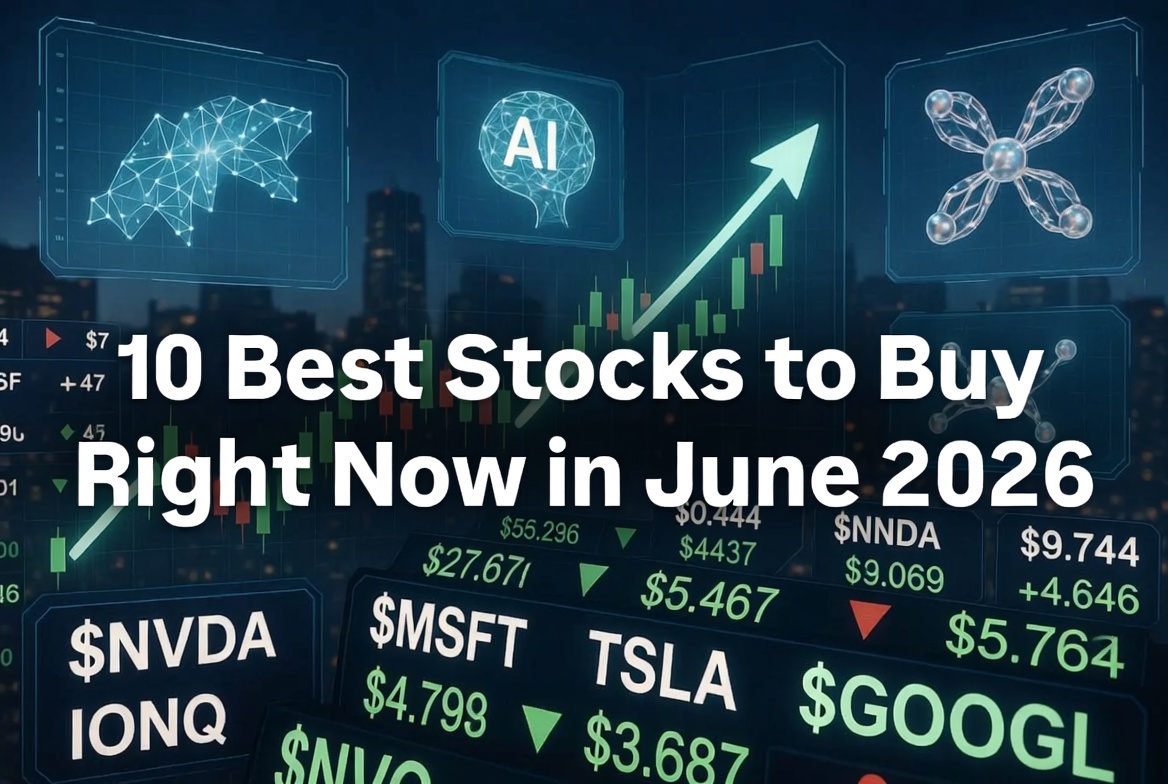
10 Best Stocks to Buy Right Now in June 2026 – My Current Watchlist
AI spending continues as the dominant long-term theme, but capital is rotating toward companies with strong earnings, reasonable valuations, and real infrastructure exposure.

Quantum AI Is Already Reshaping Markets
I've traded through enough hype to know quantum AI won't flip everything overnight. But the 2026 signals — funding, hybrids in finance, hardware progress — say it's accelerating. The players and platforms that nail security and optimization will carry the edge.

Biolongevity Screening
Why screen? Silent processes like chronic inflammation (inflammaging), mitochondrial dysfunction, and senescent cell accumulation drive most age-related decline. Biolongevity screening uncovers these before symptoms appear, enabling proactive biohacking strategies
The Compute Market Boom
BlackRock CEO Larry Fink’s recent endorsement of compute as a new asset class, the impending launch of CME compute futures, massive hyperscaler deals such as Google’s $920 million monthly commitment to SpaceX
Every story, signed and delivered.
Subscribe to the kxco channel and get the headline, the AI-written key takeaways, and the chain-anchor link the moment we publish. Audio versions and per-ticker subscriptions arrive in the next iteration.