
Nvidia's Nemotron 4 and the Open-Source Push
The chip giant is building a trillion-parameter open model. Shayne Heffernan on what it does to OpenAI, Anthropic, Meta, AMD and the enterprise API bill, and why the live KXCO ontology says it tightens Nvidia's grip rather than loosening it.
Part of theAI Stocks Center
Nvidia is not content to just sell the picks and shovels anymore. According to a report from The Information, carried by Reuters this week, the company is building a new family of open-weight AI models called Nemotron 4. The largest version is expected to hit at least 1 trillion parameters. The goal is straightforward: challenge the best open-source models in the world and give enterprises a serious Western alternative they can actually run themselves.
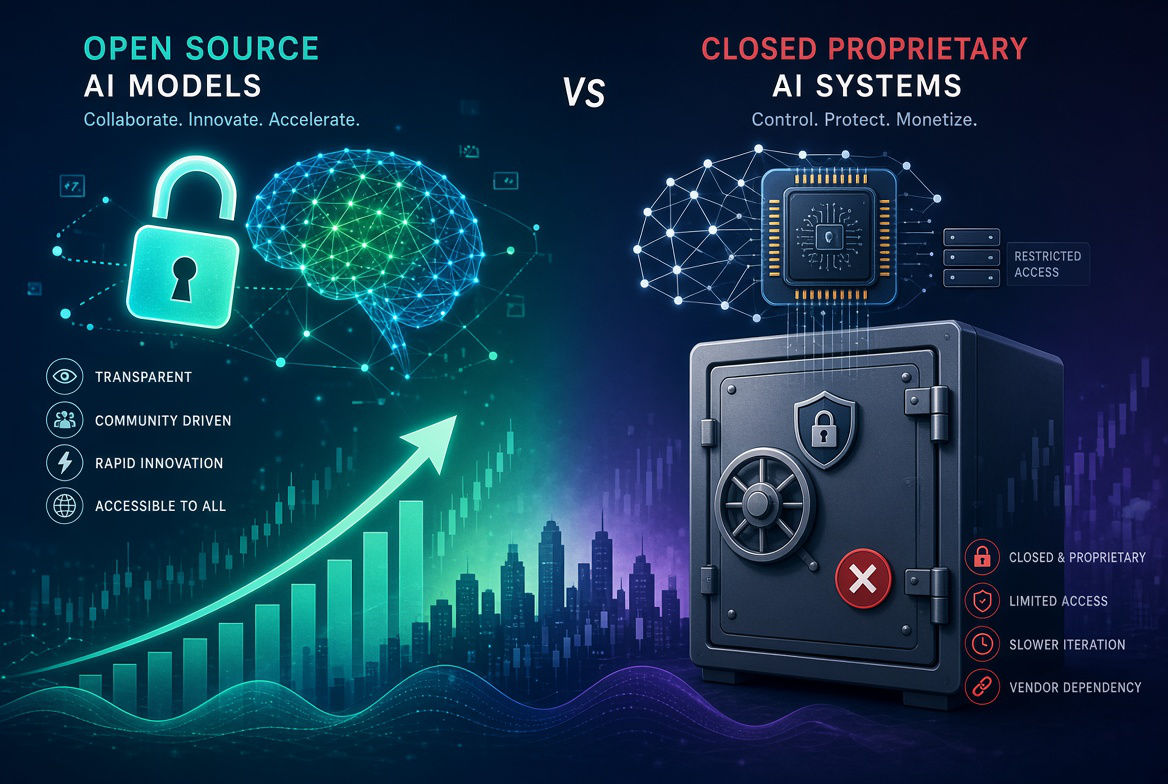
Open weights against closed systems. This is the tension Nemotron 4 intensifies rather than creates.
This is not a side project. It lands at a moment when enterprise AI bills have become painful, Chinese open models have closed the performance gap at a fraction of the price, and the closed labs, OpenAI and Anthropic, still treat their best systems like carefully guarded toll roads. Nvidia's move is about protecting its hardware franchise while forcing the rest of the industry to adapt.
I have watched this industry long enough to know when a chip company starts writing software at this scale, the stock implications and the competitive fallout are rarely small. Let's walk through what is actually happening, who gets hurt, who benefits, and where the real leverage sits.
What we actually know about Nemotron 4
Nvidia has been in the model game for years under the Nemotron name. Earlier versions were useful for synthetic data generation, reward modeling, and demonstrating what their GPUs could do. They were not trying to sit at the top of the leaderboard. That changes with version 4.
The Information, citing people working on the project, says the largest model will carry at least a trillion parameters. Final training is not finished. Employees involved think a late-fall release is possible, though Nvidia has not confirmed a date. The company did say it is investing in Nemotron because every company and every country needs accessible frontier open models for safety, security, and innovation that lasts across generations.
This sits on top of earlier work. Nvidia already released Nemotron-4 340B models in 2024 with strong synthetic-data pipelines and reward models. More recently it has rolled out the Nemotron 3 family, Nano, Super and Ultra, and, just this week, Nemotron 3.5 Lightning, a smaller and faster mixture-of-experts model aimed at agentic workloads. There is also the Nemotron Coalition announced earlier this year, bringing in labs such as Mistral, Perplexity, LangChain and others to share data, evaluation methods, and expertise while Nvidia supplies the heavy compute on DGX Cloud. The first shared base model from that group is meant to feed directly into Nemotron 4.
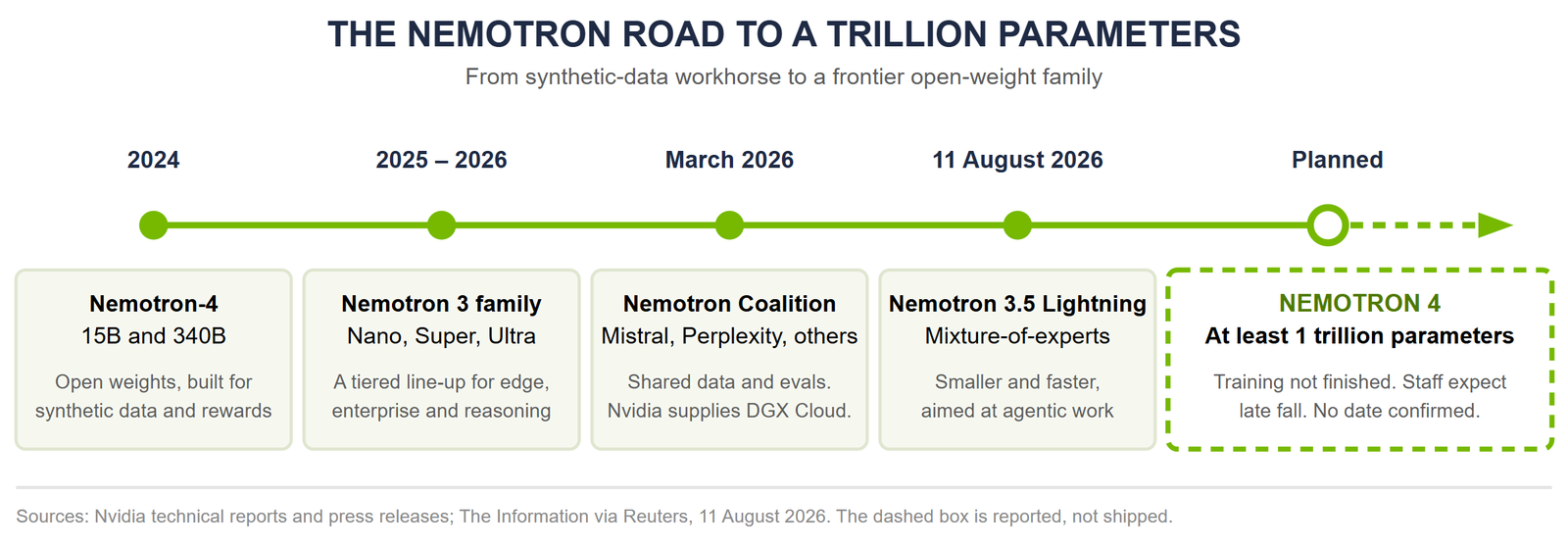
The Nemotron line before Nemotron 4. Everything to the left of the dashed box has shipped. The flagship has not.
The practical design will almost certainly include multiple sizes. Smaller models for edge and cost-sensitive inference. Mid-size for general enterprise work. The trillion-parameter flagship for the hardest reasoning and coding tasks. Everything will be tuned hard for TensorRT-LLM and Triton so that peak performance stays locked to Nvidia silicon. That is the quiet part of the strategy: the weights may be open, but the fastest, cheapest way to run them will still prefer Nvidia's stack.
Why Nvidia is doing this now
Two pressures have become impossible to ignore. First, the enterprise bill shock. Companies that started with GPT-4 or Claude APIs for document summarization and light coding suddenly found themselves processing thousands of long regulatory filings, earnings transcripts, or customer interactions every day. Token costs compound fast. At the same time, data-privacy rules in finance, healthcare, and government make sending sensitive material to a third-party API a non-starter for many workloads. Self-hosting an open-weight model on internal hardware starts looking rational once the monthly API invoice crosses a certain line.
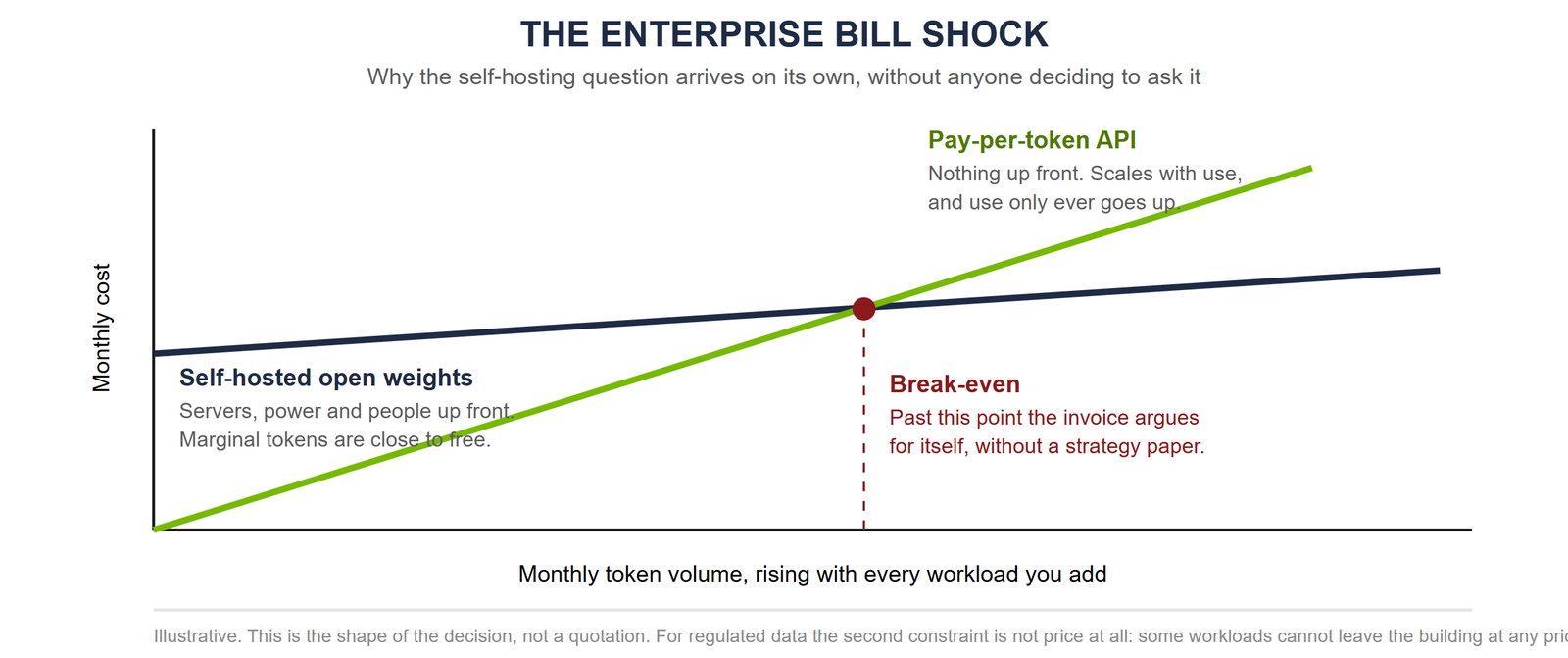
Two cost curves and one crossing point. Illustrative, and deliberately carrying no price quotation. For regulated data the second constraint is not price at all, because some workloads cannot leave the building at any price.
Second, Chinese models got good, and cheap, faster than many expected. Export controls limited access to the highest-end Nvidia chips, so Chinese labs responded with architectural efficiency. Mixture-of-experts designs that activate only a fraction of parameters, heavy use of synthetic data, and aggressive optimization produced systems that approach or match Western frontier performance on many benchmarks while costing a fraction to run. Developers outside the United States noticed. When the open Chinese options are good enough and dramatically cheaper, the default stack starts shifting east unless a strong Western alternative appears.
Nvidia sits in the middle of both problems. It sells the GPUs that power the closed labs and the open Chinese labs. If the open Chinese models become the global default for self-hosted work, optimization work drifts toward whatever hardware those models run best on, and that may not always be the newest Nvidia generation. By releasing a top-tier open Western model family optimized for its own software stack, Nvidia keeps the developer and enterprise ecosystem tied to CUDA and TensorRT while giving buyers a credible way to cut API bills without going offshore.
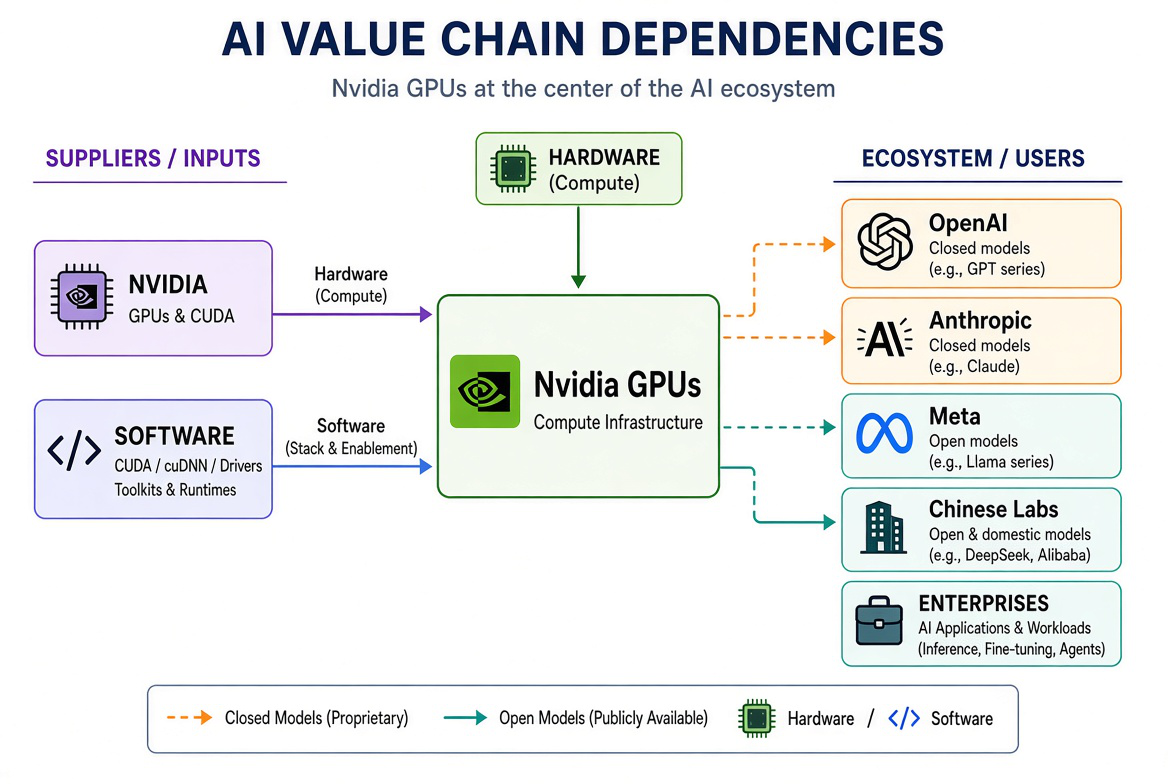
Simplified value-chain dependencies. Open and closed model paths both still rely heavily on the same hardware layer.
How this hits OpenAI and Anthropic
The closed labs have built impressive businesses on the idea that the very best intelligence is only available through them, under their terms, at their prices. That model works while the capability gap is large and the alternative is weak. It starts to fray when capable open models become free to download and run inside the firewall.
OpenAI long ago left its original open-source posture behind. Safety arguments and the obvious commercial logic of a high-margin API business made that shift permanent. Anthropic has been even more explicit about the risks of releasing frontier weights. Once the weights are public they cannot be recalled or patched centrally. Dario Amodei's public skepticism of open-weight frontier models is consistent and well-known.
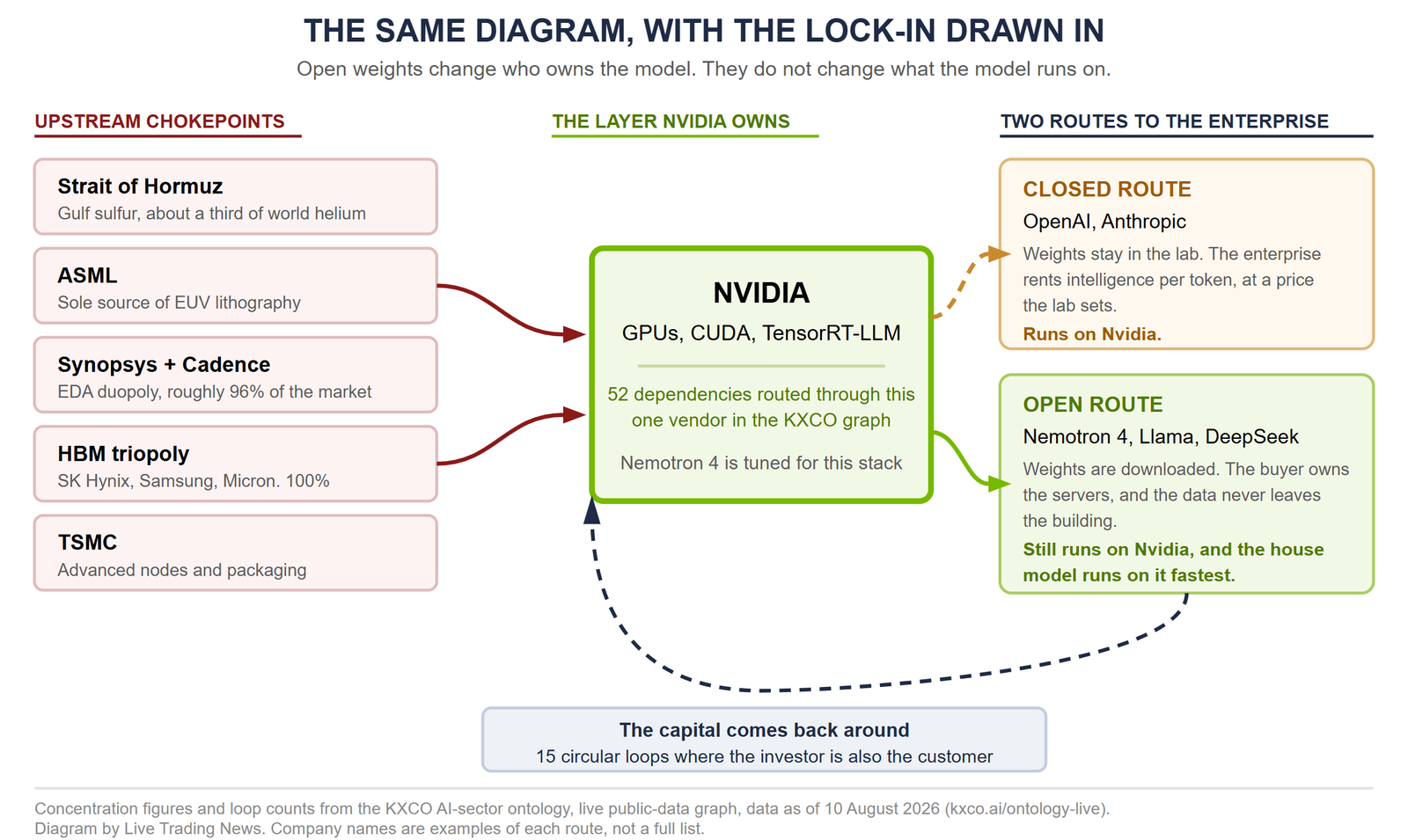
The same picture with the lock-in drawn in. Both routes terminate on the same silicon, and four of the five upstream chokepoints have no second source. Concentration figures from the KXCO AI-sector ontology, data as of 10 August 2026.
A trillion parameters is a big number, and it is worth being precise about what it would and would not establish. It would not be the first open model at that scale. Moonshot AI published Kimi K2 at 1 trillion total parameters with about 32 billion active per token, and DeepSeek-V3 sits at 671 billion total with roughly 37 billion active. Both are downloadable today. Meta's Llama 3.1 405B is dense, so every one of those parameters is paid for on every token. The closed frontier models publish no parameter counts at all.
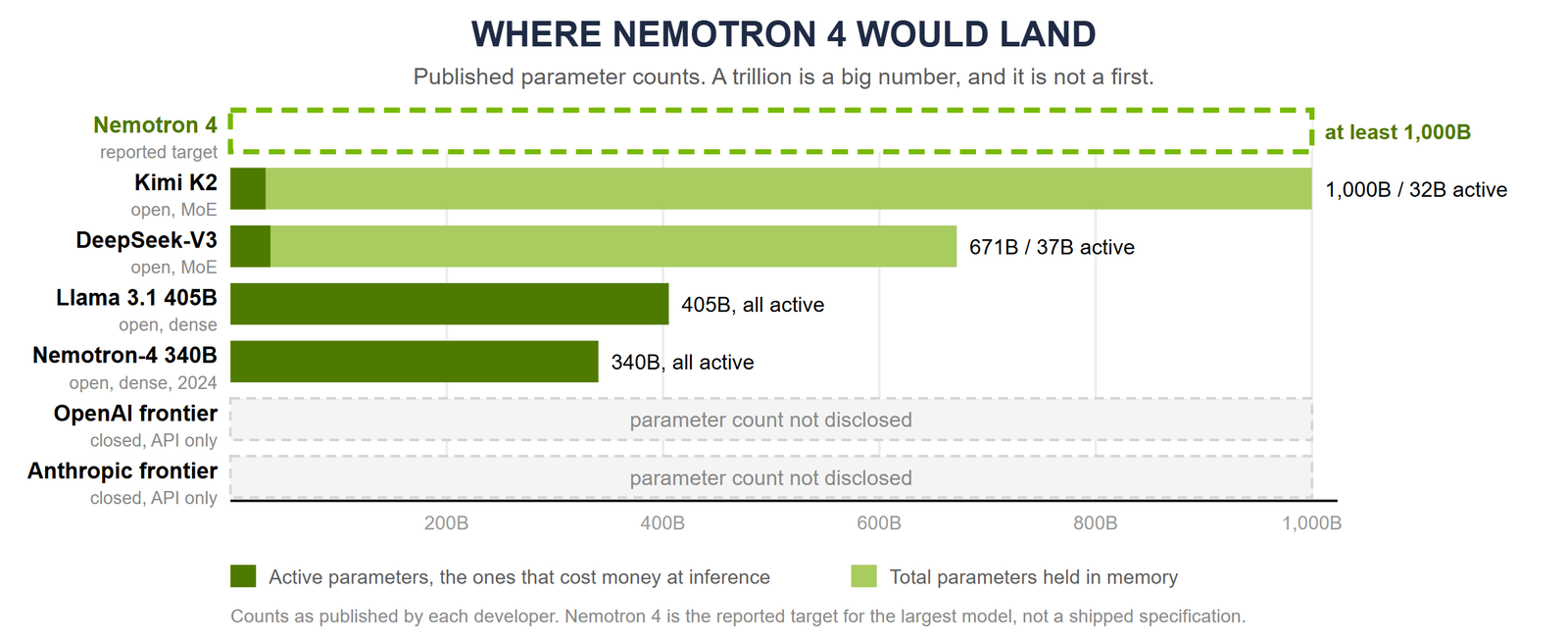
Where Nemotron 4 would land, on published counts. Scale is not the moat.
Model | Weights | Where it runs | What the buyer pays for |
|---|---|---|---|
Nemotron 4 (planned) | Open, expected | Customer hardware, tuned for TensorRT-LLM and Triton | Servers, power and staff. Nvidia captures the hardware. |
Kimi K2, DeepSeek-V3 | Open | Customer hardware, anywhere, including offshore stacks | Servers and staff, at the lowest published inference cost |
Llama 3.1 405B | Open | Customer hardware or any cloud | Servers and staff. Dense, so every parameter is paid for. |
OpenAI frontier | Closed | Vendor infrastructure only | Per token, at a price the vendor sets |
Anthropic frontier | Closed | Vendor infrastructure only | Per token, at a price the vendor sets |
The commercial difference is not benchmark position. It is who owns the machine the model runs on.
Nemotron 4 does not have to beat GPT-5 or Claude's latest on every benchmark to matter. It only has to be close enough, open enough, and cheap enough to run that a large fraction of enterprise workloads move off the closed APIs. High-volume, lower-stakes tasks such as document processing, internal search, code completion and agent scaffolding are the first to leave. The expensive frontier calls that remain will still generate revenue, but the growth trajectory changes. Volume that used to flow through the API now sits on customer-owned hardware.
There is also a narrative cost. Every credible open model that approaches the closed frontier makes the "you need us for safety and quality" argument harder to sustain in boardrooms. Investors who have assigned lofty private valuations to OpenAI and Anthropic on the basis of durable pricing power will start asking sharper questions about long-term margins. The closed labs will respond with better enterprise features, tighter integrations, stronger safety tooling, and continued capability leadership. But the competitive set has expanded, and the pricing power is no longer absolute.
Broader company impacts
Meta $META has been the main American open-weight standard-bearer with the Llama series. Llama 3.1 405B showed that open models could reach serious scale. Deployment cost and efficiency still matter, though, and Chinese models have been winning on the efficiency axis. Nemotron 4 arrives as both a competitor and a potential complement. Meta benefits from a healthier overall open ecosystem because it reduces the risk that Chinese models become the global default. At the same time, Nvidia's model will be aggressively optimized for Nvidia hardware in ways Llama is not. Enterprises that standardize on Nemotron will still buy a lot of GPUs. They just may buy fewer pure Llama deployments.
Mistral already sits inside the Nemotron Coalition. That relationship is more collaborative than adversarial. A stronger Nvidia open stack can raise the floor for European open models rather than crush them, provided the licensing and distribution stay practical. Cloud providers face a mixed picture. Microsoft's $MSFT Azure OpenAI service and Google's $GOOGL Gemini offerings make money from closed-model inference. More self-hosting reduces some of that revenue. Yet the same customers still need cloud GPUs, managed Kubernetes, and enterprise support when they run open models at scale. The mix shifts. The total compute demand does not necessarily shrink.
AMD $AMD and other accelerator makers get an ambiguous signal. Open models in principle make it easier to target non-Nvidia hardware. In practice, Nvidia will ship Nemotron with the tightest possible integration to its own inference stack. Closing that optimization gap takes real engineering time and money. AMD's path remains harder, not easier, in the short term. Chinese labs lose some soft-power advantage if a strong Western open alternative exists. Developers who previously reached for the cheapest capable Chinese model now have a high-performance option that carries fewer geopolitical and compliance questions for Western enterprises.
Stock focus and the hardware reality
Nvidia's $NVDA stock reaction to the Nemotron 4 report was muted, essentially flat on the day. That makes sense. The market already prices Nvidia as the dominant supplier of AI training and inference silicon. A new open model is not incremental software revenue of any meaningful size. It is a demand-generation tool for the next wave of GPU purchases.
The logic is simple. Training a trillion-parameter model is expensive even for Nvidia, but it is still a rounding error next to the multi-year GPU revenue that follows if enterprises standardize on that model. Every company that decides to self-host rather than pay per-token is still buying servers full of H100s, Blackwell, or whatever comes next. Nvidia is giving away the brain to sell more of the nervous system.
Look through the KXCO ontology and the live AI-sector map and the concentration becomes clearer. The graph of public data shows how capital, compute, model development, and enterprise deployment all still funnel through a surprisingly small set of chokepoints: lithography, advanced packaging, high-bandwidth memory, and the CUDA software layer. Open models do not dissolve those chokepoints. They often reinforce the ones Nvidia already controls. When the best open Western model runs fastest on Nvidia silicon, the dependency graph tightens rather than loosens.
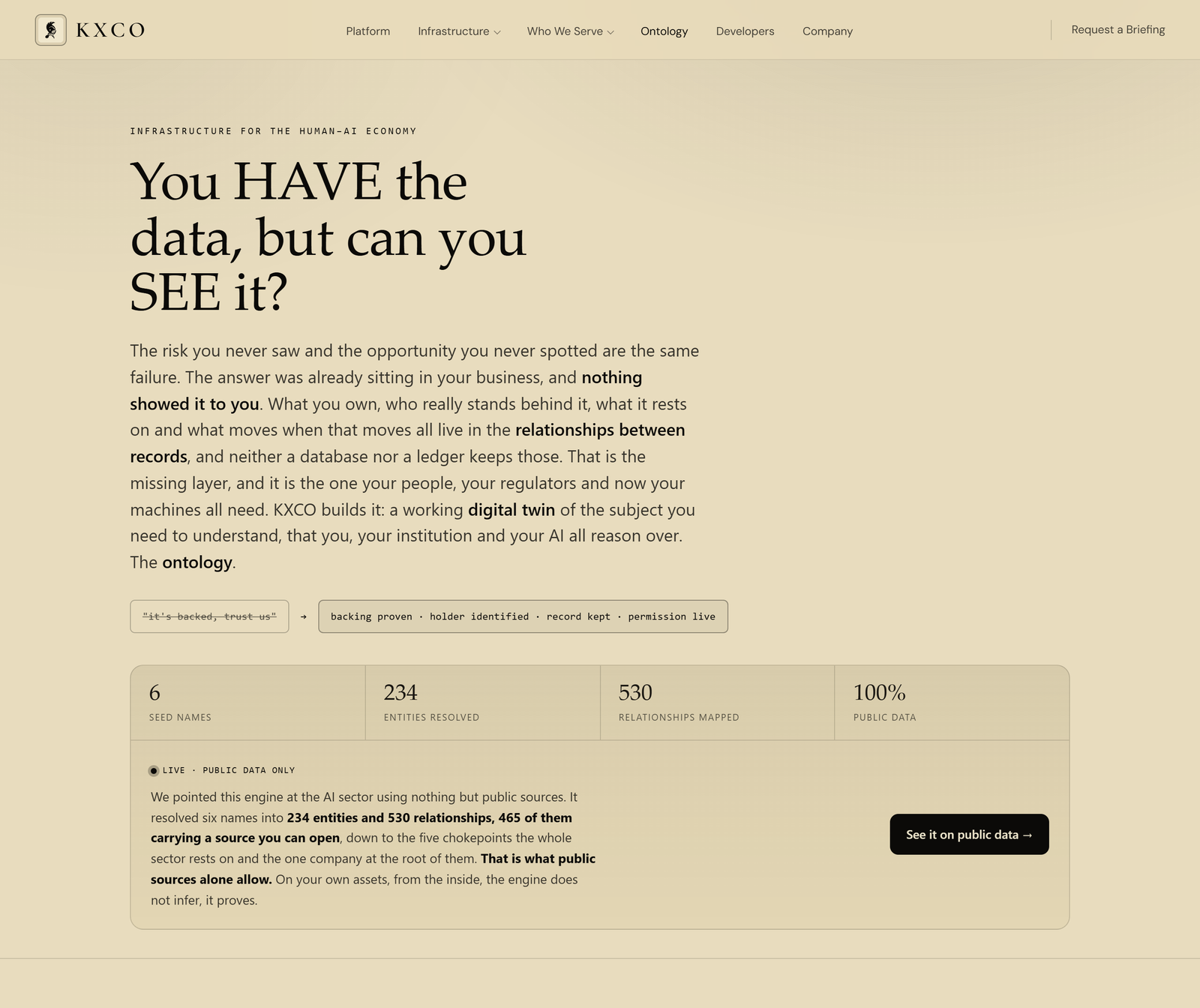
The public entry point at kxco.ai/ontology. Six seed names resolve into 234 entities and 530 relationships, 465 of them carrying a source you can open, on public data only.
What the live graph says about this argument
The live map is worth reading rather than skimming, because the Nvidia finding there is not a general observation about market share. It is a count of routed dependencies, and the number sitting on the card is 52.
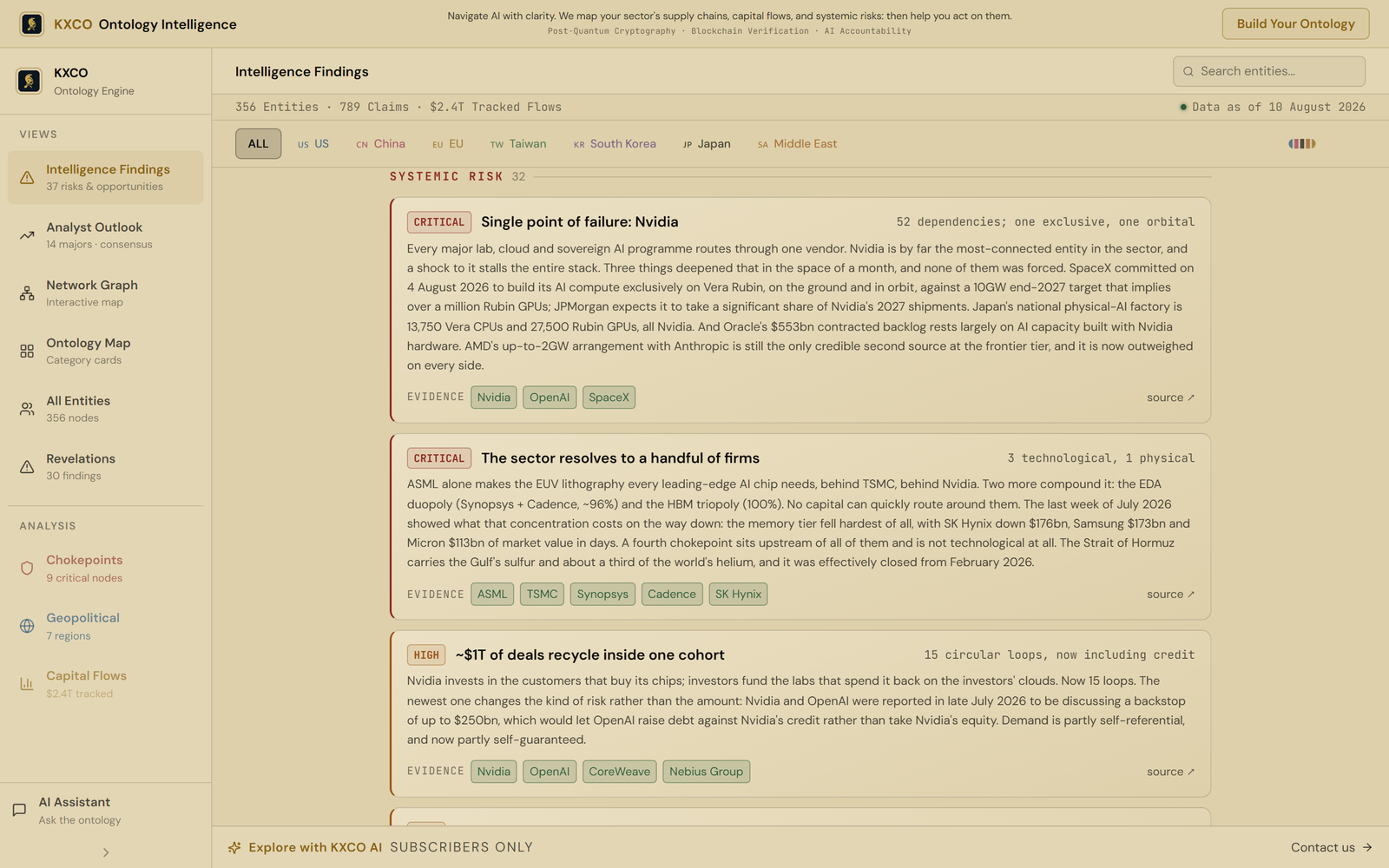
Three findings, stacked. Source: kxco.ai/ontology-live, 356 entities and 789 claims, data as of 10 August 2026.
Three of the entries behind that count landed inside a single month, and none of them was forced. SpaceX committed on 4 August 2026 to build its AI compute exclusively on Vera Rubin, on the ground and in orbit, against a 10GW end-2027 target that implies over a million Rubin GPUs. Japan's national physical-AI factory is specified as 13,750 Vera CPUs and 27,500 Rubin GPUs, all Nvidia. Oracle's $ORCL contracted backlog of $553bn rests largely on AI capacity built with Nvidia hardware. AMD's up-to-2GW arrangement with Anthropic is logged as the only credible second source at the frontier tier, and it is outweighed on every side.
The second critical finding is the one that matters for anyone modelling the downside. ASML $ASML alone makes the EUV lithography every leading-edge AI chip needs, sitting behind TSMC $TSM, sitting behind Nvidia. The EDA duopoly of Synopsys and Cadence holds roughly 96% of that market, and the HBM triopoly holds 100% of high-bandwidth memory. The last week of July 2026 showed what that concentration costs on the way down, when the memory tier fell hardest of all: SK Hynix down $176bn, Samsung $173bn and Micron $113bn of market value in days. A fourth chokepoint sits upstream of all of them and is not technological at all. The Strait of Hormuz carries the Gulf's sulfur and about a third of the world's helium, and it has been effectively closed since February 2026.
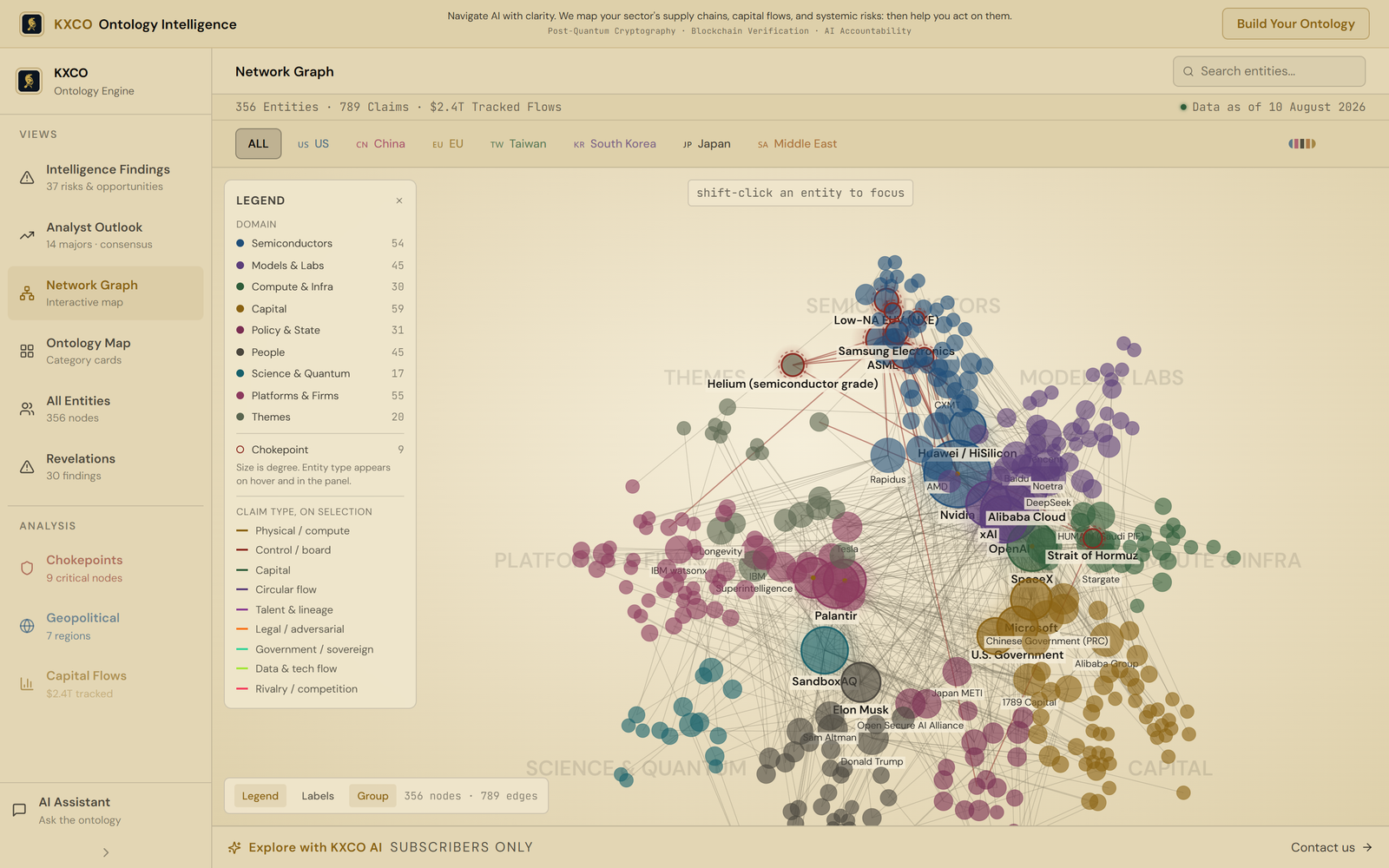
The network view, 356 nodes and 789 edges across nine domains. The ringed nodes are the nine chokepoints, and they sit at the top of the map, upstream of everything the market actually watches.
A trillion-parameter open model that runs fastest on the same silicon adds to that dependency count rather than reducing it. That is the part the open-source framing tends to obscure. Open weights change who owns the model. They do not change what the model runs on, and they do nothing at all about the four suppliers with no second source.
The geopolitical and safety overlay
Washington continues to debate how tightly to regulate open-weight models. National-security voices worry about proliferation. Industry voices counter that if the United States restricts open models, the rest of the world will simply adopt the Chinese ones. Nvidia's public posture, that accessible frontier open models strengthen safety and give countries a foundation they can rely on, is an explicit bet on the second camp.
By putting a serious American open model into the market, Nvidia gives policymakers a concrete alternative to either pure closed systems or Chinese open systems. That political cover matters. It also creates a feedback loop: the more enterprises adopt Nemotron, the stronger the argument becomes that open Western models are the safer long-term path for democratic countries. Safety concerns do not disappear. Open weights cannot be centrally patched or revoked. Nvidia and the coalition will have to show that the models can be steered, audited, and hardened for enterprise and government use.
Technical edges that matter
Nvidia's advantages are not mysterious. It has earlier access to its own next-generation silicon for training. It has deep experience generating high-quality synthetic data so that models are not limited by the noisy public web. It owns the inference software stack that most enterprises already use. And it can co-design the model architecture with the hardware in ways that pure software labs cannot match.
Mixture-of-experts designs, aggressive quantization, and TensorRT-specific kernels are the obvious levers. If Nemotron 4 delivers competitive quality at meaningfully lower inference cost on Nvidia GPUs than rival open models, the adoption decision becomes easy for many buyers. That is the real product requirement. Benchmarks matter, but total cost of ownership and operational simplicity matter more once the model is inside the firewall.
Where this leaves the market
The AI industry is moving from a period in which a few closed labs owned the frontier to a more layered market. Frontier closed models will still win the hardest reasoning tasks and the consumer products that need the absolute best. Open models will take a larger share of the volume, especially anything that can be self-hosted for cost or compliance reasons. Hardware suppliers that control the efficient execution of those open models will capture a disproportionate share of the resulting spend.
Nvidia is positioning itself on both sides of that transition. It continues to supply the closed labs while simultaneously seeding the open alternative that reduces dependence on those same labs. The strategy is coherent once you accept that Nvidia's real product is not the model weights. It is the platform that makes running any serious model practical at scale.
The ontology makes the interdependencies visible in a way that traditional research notes rarely do. Follow the relationships far enough and you see the same concentration points appearing under different labels: chip design, foundry capacity, software ecosystems, and capital flows that circle back as customers. Fifteen of those loops are mapped, and about $1tn of deals recycle inside one cohort. Nemotron 4 is one more node in that graph, designed to keep more of the value creation attached to Nvidia's corner of it.
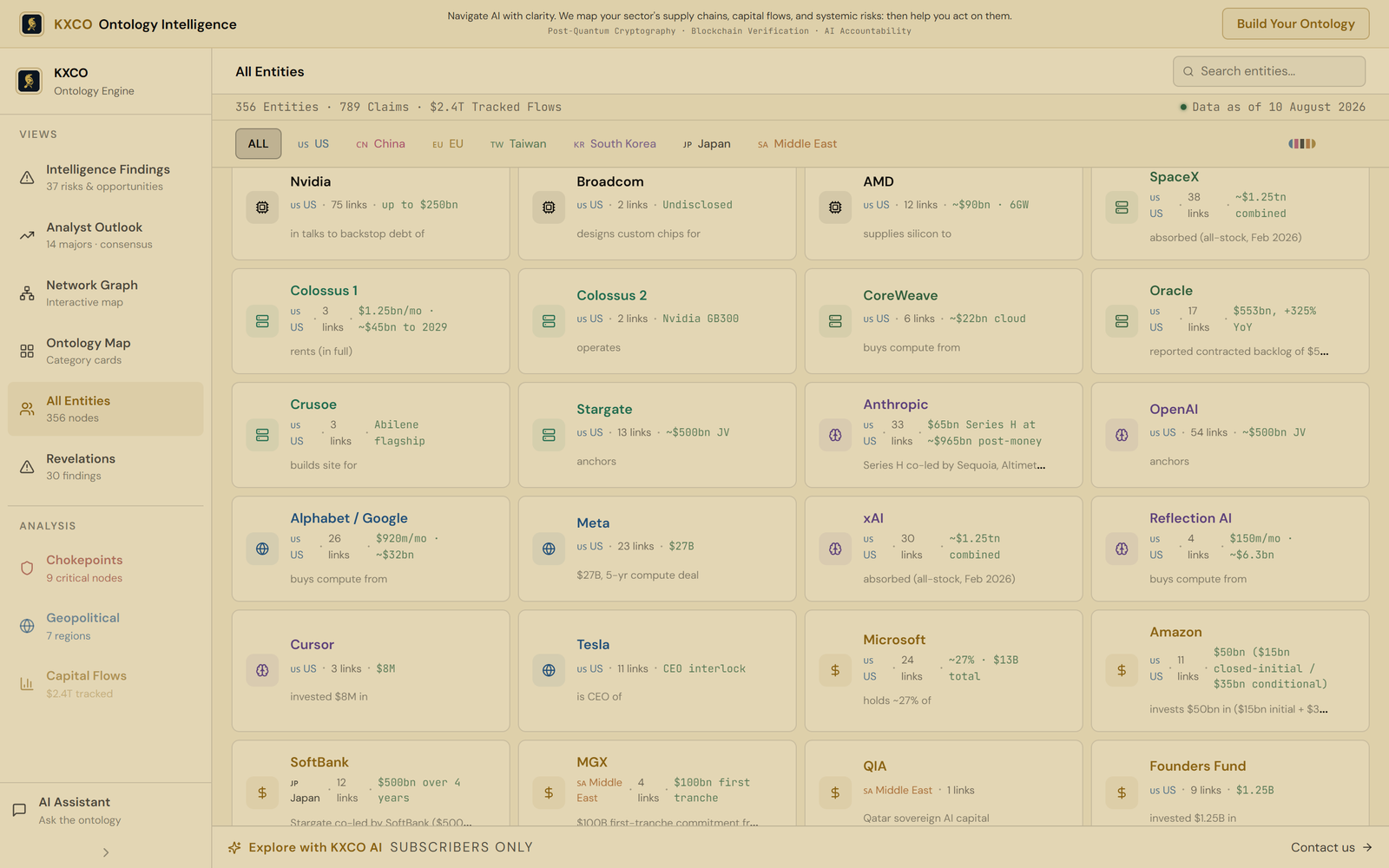
The capital-flow entities behind those loops, each card carrying the size of the commitment and the number of mapped links. Source: kxco.ai/ontology-live, $2.4tn tracked, data as of 10 August 2026.
Whether the trillion-parameter model ships on time and performs as hoped is still an open question. The direction of travel is not. Open-source AI is no longer a side show or a research curiosity. It is becoming the default path for a large and growing share of enterprise workloads, and it changes how the whole AI stocks complex should be read. Nvidia has decided it would rather shape that shift than watch it happen from the sidelines. The rest of the industry, closed labs, cloud providers, competing chipmakers, and the investors who fund them, will have to adjust their assumptions accordingly.
The fight for the foundation layer of AI is now fully underway. The company that sells the most GPUs just put its own model into the arena.
Sources and disclosure
Reuters, "Nvidia building 1-trillion-parameter Nemotron 4 to rival open AI models, The Information reports," 11 August 2026. NVIDIA statement via Kari Briski, Vice President of Generative AI. NVIDIA Nemotron Coalition announcement and GTC 2026 materials, March 2026. NVIDIA technical reports on Nemotron-4 15B and 340B (2024) and the Nemotron 3 series, including Nemotron 3.5 Lightning, 11 August 2026. Parameter counts are as published by each developer: Nvidia, Meta, DeepSeek and Moonshot AI. Concentration, chokepoint and capital-loop figures are read from the public KXCO AI-sector ontology at kxco.ai/ontology-live, which reports 356 entities, 789 claims and $2.4tn of tracked flows, data as of 10 August 2026. The cost-curve graphic is illustrative and carries no price quotation.
Disclosure: Live Trading News and KXCO are part of the same group. The ontology described here maps entities, claims and dependencies from public sources. It makes no price forecasts, and nothing in this article is investment advice.

Quantum Cybersecurity: The KXCO Chain Is Already Running
The World Economic Forum warned on 11 September that the quantum-safe race has changed gears. It is right about the direction and late about the work. Every KXCO product already runs on NIST's post-quantum algorithms, and all of them run on the same implementation: 42 package manifests declare one library. The chain verifies ML-DSA-65 on-chain at precompile 0x0b, tested live with three negative controls. NIST's own grader marked the library at 2,130 cases and zero failures.

What the KXCO Ontology Exposed While the Market Stood Still
On 25 August the KXCO AI Sector Ontology stamped a fresh set of rows. Sixteen days later the Nasdaq had gone nowhere and ten of those names were up: Intel 14.68%, Meta 13.04%, SpaceX 7.42%, Oracle 5.65%. This is what a record of 393 entities and 869 sourced claims surfaces that a screen cannot: who is genuinely irreplaceable rather than merely large, which obligations sit off every balance sheet in the sector, and where the strongest bull case on the page runs into a variable no graph contains.
China's AI and Quantum Ambitions
China is no longer trying only to train a model that looks like an American one. It is trying to own the stack that turns tokens into factories: open-weight models cheap enough to run at home, accelerators that do not need an Nvidia licence, robots that walk into a BYD plant, quantum machines that list on the STAR Market, and a power system that can add the generating capacity of a mid-sized country in a single year. The models, the tickers, and the 27 claims that cross the border.
AI and Quantum Update
The first week of September 2026 compressed a year of argument into seven days. GPT-6 Astra landed at the Critical cybersecurity level of OpenAI's own Preparedness Framework, Nvidia agreed to buy Hugging Face for $12.93 billion, Washington took minority equity in three quantum companies, and Mistral closed the largest equity raise in European technology history. A field report on the breakthroughs, the tickers, and a map that has split three ways.
Every story, signed and delivered.
Subscribe to the kxco channel and get the headline, the AI-written key takeaways, and the chain-anchor link the moment we publish. Audio versions and per-ticker subscriptions arrive in the next iteration.